
Modafinil vs Caffeine: Focus, Duration and Sleep Research
Modafinil and caffeine both promote wakefulness, but they act through different systems. Caffeine blocks adenosine signaling, while modafinil affects dopamine transporters and other wakefulness pathways. Modafinil is a prescription medication for specific sleep disorders; caffeine is widely available in coffee, tea and other products.[1][2][3]
The most useful comparison comes from trials that measured alertness directly. Those results, together with duration and sleep effects, explain more than describing one substance as a stronger version of the other.
Modafinil vs Caffeine at a Glance
The main differences concern pharmacology, access and how long effects can continue after consumption.
| Feature | Modafinil | Caffeine |
|---|---|---|
| Primary role | Prescription treatment for excessive sleepiness | Widely consumed stimulant |
| Mechanism | Dopamine-transporter inhibition; other wakefulness pathways | Adenosine-receptor antagonism |
| US access | Schedule IV prescription medicine | Foods, drinks and OTC products |
| Sleep concern | Long persistence; insomnia | Timing and amount can disrupt sleep |
Coffee contains varying amounts of caffeine. FDA figures put a typical 12-ounce brewed coffee at approximately 113 to 247 mg, so a cup is an imprecise unit for comparing exposure.[4]
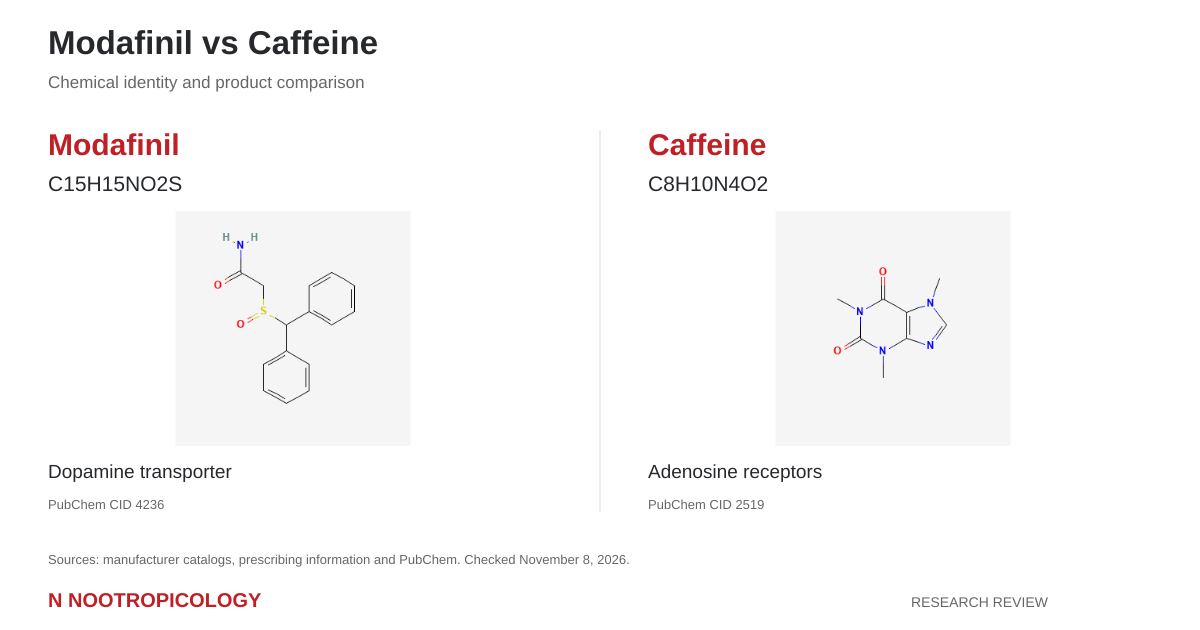
Modafinil vs Caffeine: How Their Actions Differ
Caffeine blocks adenosine receptors involved in sleep pressure. Modafinil inhibits dopamine reuptake and affects other wakefulness pathways. These are different pharmacological actions, so comparing milligrams alone does not measure equivalent effects.[1][3]
The modafinil review covers its mechanisms and general clinical research. The accompanying video provides that ingredient background.
What Happened in the Direct Comparison Trial?
Wesensten and colleagues studied 50 healthy adults kept awake for 54.5 hours. After 41.5 hours awake, groups received placebo, modafinil 100 mg, 200 mg or 400 mg, or caffeine 600 mg. Each group contained 10 participants.[5]
Modafinil 200 mg and 400 mg improved performance and alertness compared with placebo. Their effects were comparable to caffeine 600 mg, particularly during the early-morning circadian low. Differences between the modafinil doses were not statistically significant.
These were supervised sleep-deprivation conditions. The 600 mg caffeine dose exceeded the FDA's 400 mg daily reference for most adults and should be understood as a research protocol, not a daily intake suggestion.[4]
Duration and Effects on Sleep
Modafinil's effective elimination half-life after repeated dosing is approximately 15 hours. Its blood concentration peaks around two to four hours after administration. A late dose can therefore overlap substantially with the intended sleep period.[3]
Caffeine also persists beyond the initial boost. In a small randomized study, 400 mg caffeine taken at bedtime, three hours before bed or six hours before bed disrupted sleep. Even the six-hour condition reduced objectively measured sleep time by more than an hour.[6]
The study used a fixed 400 mg dose. Its result makes both amount and timing relevant when discussing an afternoon coffee or energy drink, especially for people already struggling with sleep.
Modafinil vs Caffeine: Safety and Access Differences
Both substances can cause anxiety and insomnia. Caffeine sensitivity varies with the amount consumed and individual response; the FDA's 400 mg daily reference applies to most adults, not everyone.[4]
Modafinil additionally carries serious skin-reaction warnings and requires a prescription. A new rash needs prompt assessment; swelling or breathing difficulty requires urgent help. The modafinil review covers its full adverse-effect and interaction profile.[3]
Coffee and tea are everyday sources of caffeine. Treatment for persistent pathological sleepiness depends on the diagnosed sleep disorder, rather than choosing whichever substance feels stronger.
Where to Buy Modafinil or Caffeine
Modafinil should be dispensed through a licensed pharmacy against a valid prescription, following local rules. In the United States it is a Schedule IV controlled medicine. The FDA's pharmacy checks include licensing, prescription requirements and access to a pharmacist.[3][7]
Caffeine is available in foods, drinks and labeled OTC products. Check the amount per serving and the number of servings in the container. The caffeine anhydrous review explains the concentrated form used in many tablets and supplements.
Modafinil vs Caffeine: Combining Them
This question concerns taking the two substances together, rather than choosing between them.
References
- Elmenhorst D, Meyer PT, Matusch A, Winz OH, Bauer A. Caffeine occupancy of human cerebral A1 adenosine receptors: in vivo quantification with 18F-CPFPX and PET. Journal of Nuclear Medicine. 2012;53(11):1723-1729.
- MedlinePlus. Caffeine.
- DailyMed. Provigil (modafinil) prescribing information.
- US Food and Drug Administration. Spilling the beans: how much caffeine is too much?
- Wesensten NJ, Belenky G, Kautz MA, Thorne DR, Reichardt RM, Balkin TJ. Maintaining alertness and performance during sleep deprivation: modafinil versus caffeine. Psychopharmacology. 2002;159(3):238-247.
- Drake C, Roehrs T, Shambroom J, Roth T. Caffeine effects on sleep taken 0, 3, or 6 hours before going to bed. Journal of clinical sleep medicine : JCSM : official publication of the American Academy of Sleep Medicine. 2013;9(11):1195-1200.
- US Food and Drug Administration. BeSafeRx: frequently asked questions.