
Modafinil vs Adderall: Uses, ADHD Research and Side Effects
Modafinil and Adderall can both increase wakefulness, but their clinical roles differ. Modafinil is approved in the United States for excessive sleepiness associated with narcolepsy, obstructive sleep apnea and shift work disorder. Adderall immediate-release tablets are approved for ADHD and narcolepsy.[1][2]
For someone comparing focus, the key distinction is the underlying diagnosis. ADHD symptoms, sleep-disorder-related sleepiness and ordinary tiredness are different problems, and the research does not give them a single treatment ranking.
Modafinil vs Adderall at a Glance
Adderall is a brand of mixed amphetamine salts. Its immediate-release tablets and extended-release capsules have separate prescribing information, so this comparison identifies the formulation where it matters.
| Feature | Modafinil | Adderall |
|---|---|---|
| Active ingredient | Modafinil | Mixed amphetamine salts |
| US ADHD approval | No | Yes |
| Narcolepsy indication | Yes | Immediate-release tablets |
| US controlled status | Schedule IV | Schedule II |
| Formulations discussed | Oral tablets | Immediate-release tablets; XR capsules |
Adderall XR is labeled for ADHD. Its release system prolongs delivery of the amphetamine salts compared with the immediate-release tablet.[3]
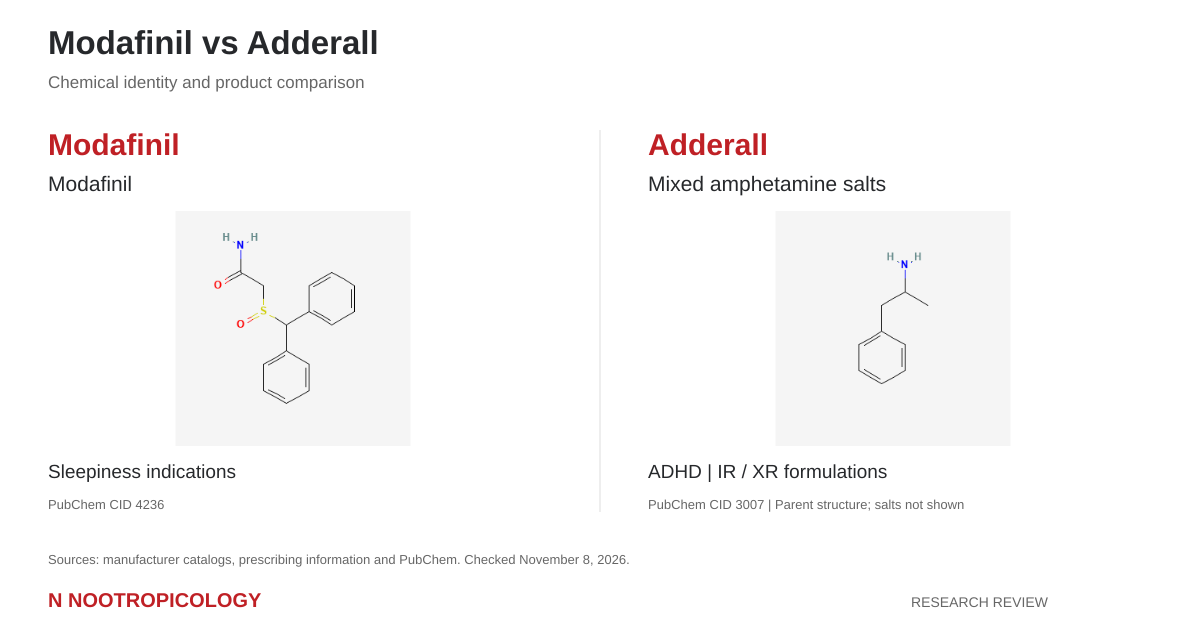
How Modafinil and Adderall Work
Modafinil inhibits dopamine reuptake. Amphetamines both inhibit reuptake and increase the release of dopamine and norepinephrine. Adderall contains dextroamphetamine and levoamphetamine in a 3:1 ratio.[1][2]
The modafinil review covers its mechanism and general clinical research. The accompanying video provides that ingredient background.
Modafinil vs Adderall for ADHD
A small randomized crossover study enrolled 22 adults with ADHD. Participants received modafinil, dextroamphetamine and placebo in separate two-week phases. Both active treatments improved the ADHD symptom checklist compared with placebo; 21 people completed the study.[4]
The comparator was dextroamphetamine, one of Adderall's components. The study did not test the Adderall mixed-salts formulation.
A subsequent nine-week modafinil trial enrolled 338 adults with ADHD, with 330 receiving study medication. It tested several daily doses against placebo and found no statistically significant improvement on the primary ADHD symptom scale in any modafinil group.[5]
Adderall XR's label describes a separate four-week study of 255 adults with ADHD. The active groups improved more than placebo on the ADHD rating scale. These findings support its labeled ADHD use, while modafinil remains outside that US indication.[3]
Wakefulness, Duration and Release Form
Modafinil reaches peak blood concentrations at roughly two to four hours and has an effective half-life around 15 hours after repeated dosing. Its labeled schedule varies with the sleep disorder being treated.[1]
Immediate-release Adderall reaches peak plasma concentrations at approximately three hours. In adults, the dextroamphetamine component has a mean elimination half-life of about 10 hours, while the levoamphetamine component is about 11.5 to 13.8 hours.[2]
Adderall XR reaches peak concentration at approximately seven hours because the capsule releases medicine over a longer period. Release time and elimination half-life describe different processes. The hours of symptom control for an individual patient are assessed during treatment, rather than read directly from a half-life table.[3]
Modafinil vs Adderall: Safety and Dependence Differences
Both medicines can cause insomnia and require review of cardiovascular and psychiatric history. Adderall has a boxed warning for abuse, misuse and addiction, including overdose and death. Its Schedule II classification differs from modafinil's Schedule IV status, although both require assessment for misuse.[2][3][1]
Modafinil carries serious skin-reaction warnings. A new rash needs prompt medical assessment; swelling or breathing difficulty requires urgent help. See the modafinil review for its complete adverse-effect and interaction information.[1]
Which Comparison Matters for the Patient?
For diagnosed ADHD, the relevant outcomes include sustained symptom improvement and daily functioning. The larger adult modafinil trial reported a negative primary result, while Adderall has an established labeled indication. For narcolepsy, both drug categories appear in prescribing information, and treatment selection considers response and tolerability.
For obstructive sleep apnea, modafinil addresses residual excessive sleepiness alongside treatment for the obstruction. Keeping someone awake does not resolve blocked breathing during sleep.[1]
A useful medication review records the diagnosis, actual release formulation, sleep schedule, symptom coverage and adverse effects. Those details give the prescriber something more specific to assess than whether a drug feels stronger.
Where to Buy Modafinil or Adderall
Both medicines require a prescription in the United States and should be dispensed through a licensed pharmacy. Ask about the prescribed formulation, available approved generics and the actual out-of-pocket cost. Immediate-release and extended-release products may have different coverage.[1][2]
For online dispensing, verify the pharmacy's license and that a pharmacist is available to answer questions. The FDA's BeSafeRx guidance recommends a valid prescription requirement as a basic check.[6]
References
- DailyMed. Provigil (modafinil) prescribing information.
- DailyMed. Adderall immediate-release tablets: prescribing information.
- DailyMed. Adderall XR extended-release capsules: prescribing information.
- Taylor FB, Russo J. Efficacy of modafinil compared to dextroamphetamine for the treatment of attention deficit hyperactivity disorder in adults. Journal of child and adolescent psychopharmacology. 2000;10(4):311-320.
- Arnold VK, Feifel D, Earl CQ, Yang R, Adler LA. A 9-week, randomized, double-blind, placebo-controlled, parallel-group, dose-finding study to evaluate the efficacy and safety of modafinil as treatment for adults with ADHD. Journal of attention disorders. 2014;18(2):133-144.
- US Food and Drug Administration. BeSafeRx: frequently asked questions.