
Cyclazodone Review: Benefits, Dosage, Side Effects & User Experiences
Cyclazodone is an experimental stimulant associated with alertness, drive and sustained concentration. Its reputation as a productivity nootropic comes largely from personal reports and early animal research. Published human evidence does not establish an effective dose, a reliable duration or a long-term safety profile.
The useful questions are what those reports actually describe, how cyclazodone differs from N-methylcyclazodone and pemoline, and which safety concerns have documented support. This review separates those compounds and replaces broad "safer stimulant" claims with the available findings. For a general supplement option, the Mind Lab Pro product below is separate from cyclazodone and does not contain it.
What Is Cyclazodone?
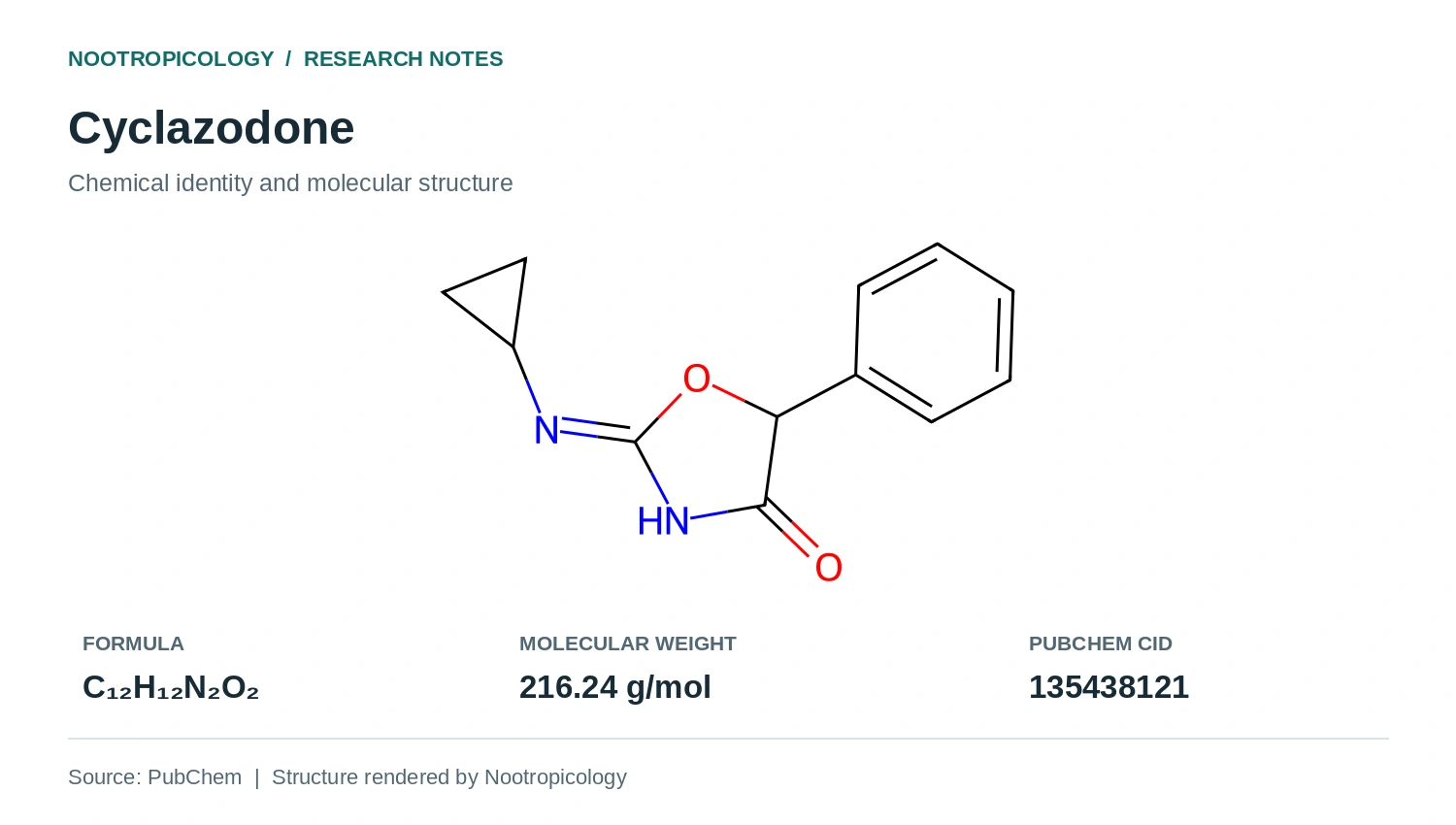
Cyclazodone is a synthetic compound in the oxazolidinone family, chemically related to pemoline. It is also called N-cyclopropylpemoline or LD 3695. Its early pharmacological literature dates to the 1960s; it never developed into a clinically established treatment with a standard prescribing regimen.[1]
| Identifier | Details |
|---|---|
| Synonyms | Cyclazodone; N-cyclopropylpemoline; LD 3695 |
| Chemical family | Oxazolidinone derivative |
| Molecular formula | C12H12N2O2 |
| Molecular weight | 216.24 g/mol |
| CAS number | 14461-91-7 |
| PubChem CID | 135438121 |
| IUPAC name | 2-cyclopropylimino-5-phenyl-1,3-oxazolidin-4-one |
| InChIKey | DNRKTAYPGADPGW-UHFFFAOYSA-N |
The chemical identifiers help distinguish cyclazodone from similarly named products. In particular, the prefix "N-methyl" changes the compound: N-methylcyclazodone is a related analog, not another spelling of cyclazodone. A report about one should retain that name when it is summarized.[2]
Cyclazodone Benefits: Alertness, Focus and Appetite
Cyclazodone attracts interest mainly for getting started on tasks and staying engaged with repetitive work. Those are plausible stimulant-related experiences, but the evidence differs sharply between animal activity measurements and people describing a productive afternoon.
Alertness and Physical Stimulation
An early patent from Les Laboratoires Dausse describes animal experiments measuring movement and appetite. The research belongs to a series of related compounds, with different results for different substitutions. It is a basis for describing cyclazodone as a stimulant candidate, rather than calling it a proven memory enhancer.[3]
Movement in a test apparatus is not the same endpoint as learning a new language, remembering material or making fewer mistakes. For a reader choosing a nootropic, that distinction is practical: feeling more activated may help initiate work, while accuracy and judgment remain separate outcomes. No controlled human cognition trial was identified in the literature reviewed for this update.
Concentration and Motivation
Users most often frame the attraction as sustained work with less reluctance to begin. That is different from a measured improvement in memory capacity. In the Reddit discussion examined below, positive reports sit alongside unpleasant stimulation and disagreements about onset, showing how variable the experience can be.
A useful productivity outcome would include accuracy as well as time spent working. The cited user thread describes persistence with homework and routine tasks, rather than standardized memory testing. There is no published effect size here that lets a reader predict a measurable improvement in study performance.
Appetite Suppression in Animal Research
The patent reports a rat appetite-suppression ED50 of 3.1 mg/kg for the cyclopropyl compound, compared with 2.6 mg/kg for d-amphetamine in that experiment. ED50 is an experimental dose-response measure, not a recommended human amount. It cannot be converted into a safe weight-loss regimen or a claim that cyclazodone matches amphetamine for focus.
Appetite loss is also an unwanted effect when it disrupts regular meals. Treating it as a benefit without a human weight-management study would confuse a stimulant effect with an established obesity treatment.
How Does Cyclazodone Work?
Cyclazodone has central stimulant activity, but its exact human molecular mechanism remains poorly characterized. Confident descriptions of specific dopamine, norepinephrine or TAAR1 effects often travel further than the available direct measurements. The primary studies reviewed here do not establish a complete receptor or transporter profile for clinical use.
What the Metabolism Research Shows
A 2026 study examined N-methylcyclazodone in pooled human liver preparations and rat urine. Researchers identified cyclazodone as an N-demethylated metabolite, with CYP2A6 making the main contribution to that metabolic step. This helps explain why cyclazodone can appear in a biological sample after exposure to the N-methyl analog.[4]
Metabolism describes how the body transforms a substance. It does not by itself identify the brain target that produces stimulation. This experiment also leaves the human elimination half-life and the duration of useful concentration unresolved.
| Question | What the evidence currently supplies |
|---|---|
| Does it have stimulant activity? | Early animal pharmacology supports that description; people also report stimulation. |
| Does it improve human memory? | No controlled clinical memory benefit was identified for this review. |
| Is N-methylcyclazodone the same drug? | No. It is a related compound that can be metabolized to cyclazodone. |
| Is its human half-life established? | The cited metabolism study does not establish a clinical elimination half-life. |
| Is it safer than prescription stimulants? | There is no adequate human comparison establishing that claim. |
Cyclazodone vs. N-Methylcyclazodone and Pemoline
The three names often appear together because they describe related chemistry. Their clinical histories and evidence are different, and those differences matter more than informal rankings of which feels "cleaner."
Cyclazodone vs. N-Methylcyclazodone
N-methylcyclazodone carries an additional methyl substitution. The 2026 metabolic finding connects the compounds biologically, but it does not provide an interchangeable dose or a reliable potency ratio. Keep the full name attached to every experience report, product listing and adverse-event account.
This is especially important for reports describing delayed or prolonged effects. A person may be discussing N-methylcyclazodone while a later summary shortens the name to cyclazodone. That loses information that could explain apparent disagreements between users.
Cyclazodone vs. Pemoline
Pemoline was a prescription ADHD drug with a documented liver-safety problem. The FDA concluded in 2005 that the overall liver toxicity risk outweighed its benefits, and U.S. sales were discontinued. FDA withdrawal notices describe that history explicitly.[5]
Cyclazodone's structural relationship to pemoline is a reason to take liver questions seriously. It does not give cyclazodone the same measured rate of liver injury, because that rate has not been established. Equally, an absence of large cyclazodone case series cannot establish that the compound avoids the problem.
Cyclazodone Dosage, Onset and Duration
There is no established clinical cyclazodone dosage. Online milligram ranges describe unsupervised use, with uncertain product identity and individual response. We do not treat those ranges as prescribing guidance or convert the old animal experiments into a human protocol.
Claims about onset and duration are similarly difficult to standardize. Reports may refer to different compounds, include other stimulants or rely on subjective recollection. The time someone first feels an effect is also different from the time blood concentrations peak, and neither is a measured elimination half-life.
Redosing because an effect seems delayed is particularly hard to justify with an unfamiliar substance. The user accounts below include a delayed, unexpectedly intense experience with the N-methyl analog. A slow subjective onset does not tell a person how much active substance is already present.
Cyclazodone Side Effects and Safety
The most decision-relevant concerns are excessive stimulation, uncertain interactions and the lack of good long-term human data. Personal reports describe anxiety, sweating, jaw tension and cardiovascular discomfort. A published toxicity case involving the related N-methyl compound provides more specific clinical detail.
What the Published Toxicity Case Reported
A 2022 toxicology abstract describes a 38-year-old man who reported repeated, very large N-methylcyclazodone exposure over five days while also taking fluoxetine and aripiprazole. He developed palpitations, tremor and involuntary movements. The ECG showed a QRS duration of 140 milliseconds and a QTc of 526 milliseconds, while creatine kinase reached 2,954 U/L. Specialized urine analysis identified cyclazodone.[6]
He improved with supportive care and was discharged on day three. The case concerns reported N-methylcyclazodone exposure, co-medication and an unusually heavy pattern of use. It documents a serious stimulant-type reaction, not the frequency of side effects at ordinary exposures or proof of isolated cyclazodone toxicity.
Interactions and Long-Term Safety
There are no well-established cyclazodone combination protocols. Adding caffeine, another stimulant or a psychiatric medication introduces extra uncertainty around heart rate, anxiety, sleep and metabolism. A pleasant initial experience provides little information about repeated exposure over months.
Questions about tolerance, dependence and withdrawal also lack good cyclazodone-specific clinical answers. The absence of a standard withdrawal schedule is not evidence that repeated use is free of dependence risk. Someone experiencing severe chest pain, fainting, marked agitation or involuntary movements after a stimulant should seek urgent medical help.
Cyclazodone User Experiences on Reddit
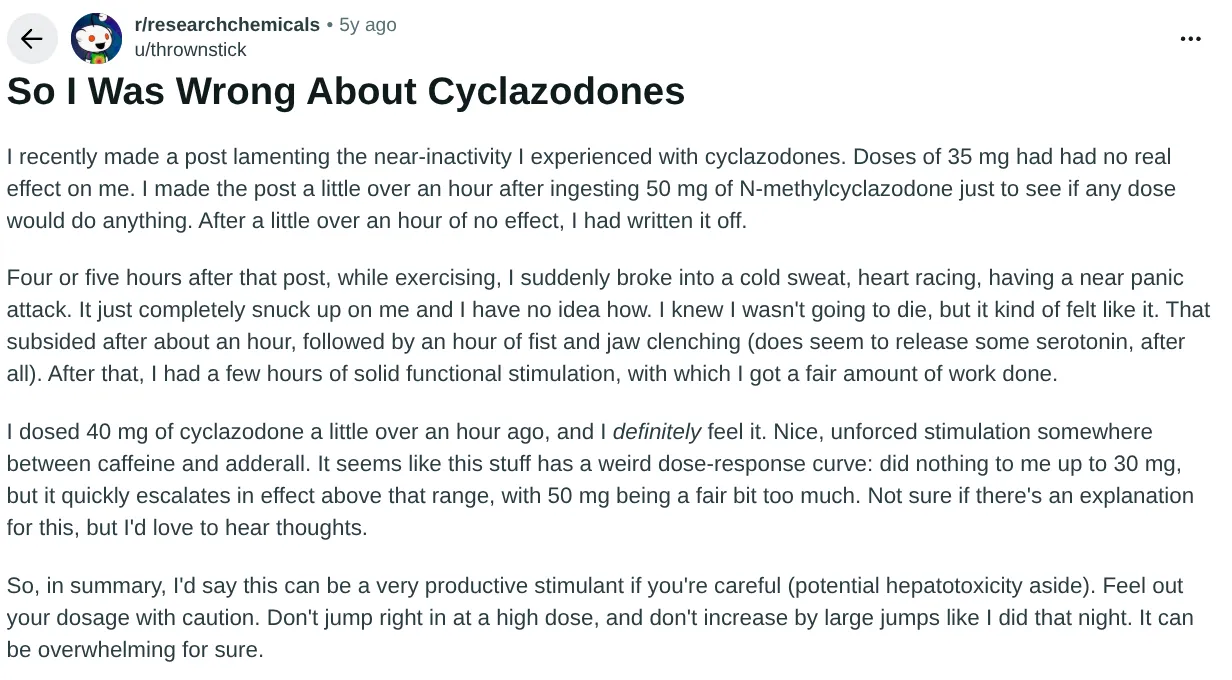
The thread "So I was wrong about cyclazodones" is useful because it discusses both compounds and includes conflicting experiences. The original poster, thrownstick, described cyclazodone as productive stimulation with less forced drive than expected. Their account of N-methylcyclazodone also included a delayed unpleasant episode with sweating, a racing heart and panic-like feelings.
Another commenter, al-dente-pasta, described working through boring homework, but also reported chest discomfort when combining the substance with caffeine. Other participants disagreed about how quickly effects appeared. These reports show both the intended productivity benefit and the practical problem of unpredictable stimulation; they are not clinical measurements or verified product tests.
Cyclazodone in Sport and Buying Considerations
Competitive athletes should not interpret the absence of a name from a short list as permission. WADA's 2026 S6 section prohibits stimulants in competition, including substances not individually named. Its separate S0 rule covers certain non-approved pharmacological substances not addressed elsewhere; an anti-doping organization can confirm the applicable classification.[7]
For a broad nootropic supplement option, consider Mind Lab Pro. It is not a stimulant-equivalent replacement or an ADHD treatment.
For readers comparing different experimental profiles, our emoxypine succinate review covers antioxidant-related research, while the N-ethyl-cypenamine review discusses another experimental compound. Each needs to be evaluated on its own evidence instead of assuming that the nootropic label implies a common safety standard.
Cyclazodone FAQ
These additional questions address drug screening and laboratory documentation, including storage, solubility, stereochemistry and batch analysis.[8][9][10][11][12]
Does Cyclazodone Show Up on a Routine Drug Test?
Cyclazodone exposure cannot reliably be ruled out by a negative routine drug screen. A published case had a negative urine immunoassay for amphetamines and six other drug groups despite cyclazodone being present. Targeted testing must include the suspected substance rather than relying only on a standard screening panel.
How Should Cyclazodone Be Stored for Laboratory Use?
Cyclazodone storage conditions depend on the specific laboratory product. Cayman Chemical specifies -20°C (-4°F) and at least four years of stability for its solid analytical reference standard. Check the matching product documentation and batch expiry date for the material being stored.
Is Cyclazodone Soluble in Water?
Cyclazodone's water solubility is listed as undetermined in Cayman Chemical's safety data sheet. The same sheet lists solubility in acetonitrile, DMSO and methanol. Those organic-solvent entries do not provide a water-solubility value.
Does Cyclazodone Have Enantiomers?
Cyclazodone has one stereogenic carbon, so two mirror-image forms, or enantiomers, are possible. PubChem leaves that stereocenter unspecified in its standard record. The name cyclazodone alone therefore does not establish whether a sample contains one enantiomer or a mixture.
What Does a Cyclazodone Certificate of Analysis Show?
A cyclazodone certificate of analysis records test results for a specific batch. For example, Cayman Chemical's certificate for batch 0694332 reports 99.9% HPLC purity, mass-spectrometry results and a conforming NMR result. Match the batch number on the container with the certificate before applying those results to a sample.
Cyclazodone Review: Our Conclusion
Cyclazodone's appeal is functional stimulation: more willingness to begin work and stay with it. The supporting evidence remains much thinner than its reputation, with animal pharmacology, scattered personal reports and limited toxicology. With no established human dose or reliable long-term safety data, it is difficult to justify presenting it as a proven everyday productivity aid.
- Giudicelli R, Najer H, Prouteau M, Sarret M. "[On some pharmacologic properties of 5-phenyl-2-cyclopropylamino-4-oxazolinone (LD 3695)]." Comptes rendus hebdomadaires des seances de l'Academie des sciences. Serie D: Sciences naturelles. 1966;262(1):213-216. ↑
- National Center for Biotechnology Information. "Cyclazodone, CID 135438121." PubChem. Accessed November 7, 2026. ↑
- Giudicelli PRL, Najer H. "5-phenyl-2-cyclopropylamino-4-oxazolinone, and process for making the same." US Patent 3609159A. Les Laboratoires Dausse. Granted September 28, 1971. ↑
- Gampfer TM, Klaes S, Eckstein N, Meyer MR. "Toxicokinetic Studies of the Two Stimulants M-ALPHA and N-Methyl-cyclazodone Using In Vitro and In Vivo Tools." Metabolites. 2026;16(5):291. ↑
- U.S. Food and Drug Administration. "Withdrawal of approval of pemoline products: liver toxicity risk." Federal Register. June 6, 2023;88:37069. Discusses the October 24, 2005 FDA safety communication. ↑
- Basile J, Nolan J, Krotulski A, Osterhoudt K. "Toxicity from the NPS N-methyl-cyclazodone with laboratory confirmation: a dance befitting St. Vitus." NACCT 2022 abstracts, abstract 240. Clinical Toxicology. 2022. doi:10.1080/15563650.2022.2107776. ↑
- World Anti-Doping Agency. "The 2026 Prohibited List." World Anti-Doping Code International Standard. Effective January 1, 2026. Sections S0 and S6. ↑
- Basile J, Nolan J, Krotulski AJ, Osterhoudt K. "Toxicity from the NPS N-Methyl-Cyclazodone with Laboratory Confirmation." CFSRE conference case report. 2022. ↑
- Cayman Chemical. "Cyclazodone product information, item 22764." January 13, 2026. ↑
- Cayman Chemical. "Cyclazodone safety data sheet." December 10, 2025; section 9. ↑
- National Center for Biotechnology Information. "Cyclazodone: stereochemistry, CID 135438121." PubChem. Accessed November 7, 2026. ↑
- Cayman Chemical. "Cyclazodone certificate of analysis, batch 0694332." Item 22764. Accessed November 7, 2026. ↑