
Sunifiram Review: DM235, Memory Research, and Safety Gaps
Sunifiram, also known as DM235 or DM-235, is an experimental piperazine derivative studied in animal memory tasks and isolated brain tissue. Its research record includes induced-amnesia experiments, glutamate-signaling studies, and measurements of hippocampal long-term potentiation. [1][2][3]
What Is Sunifiram and Its Chemical Composition?
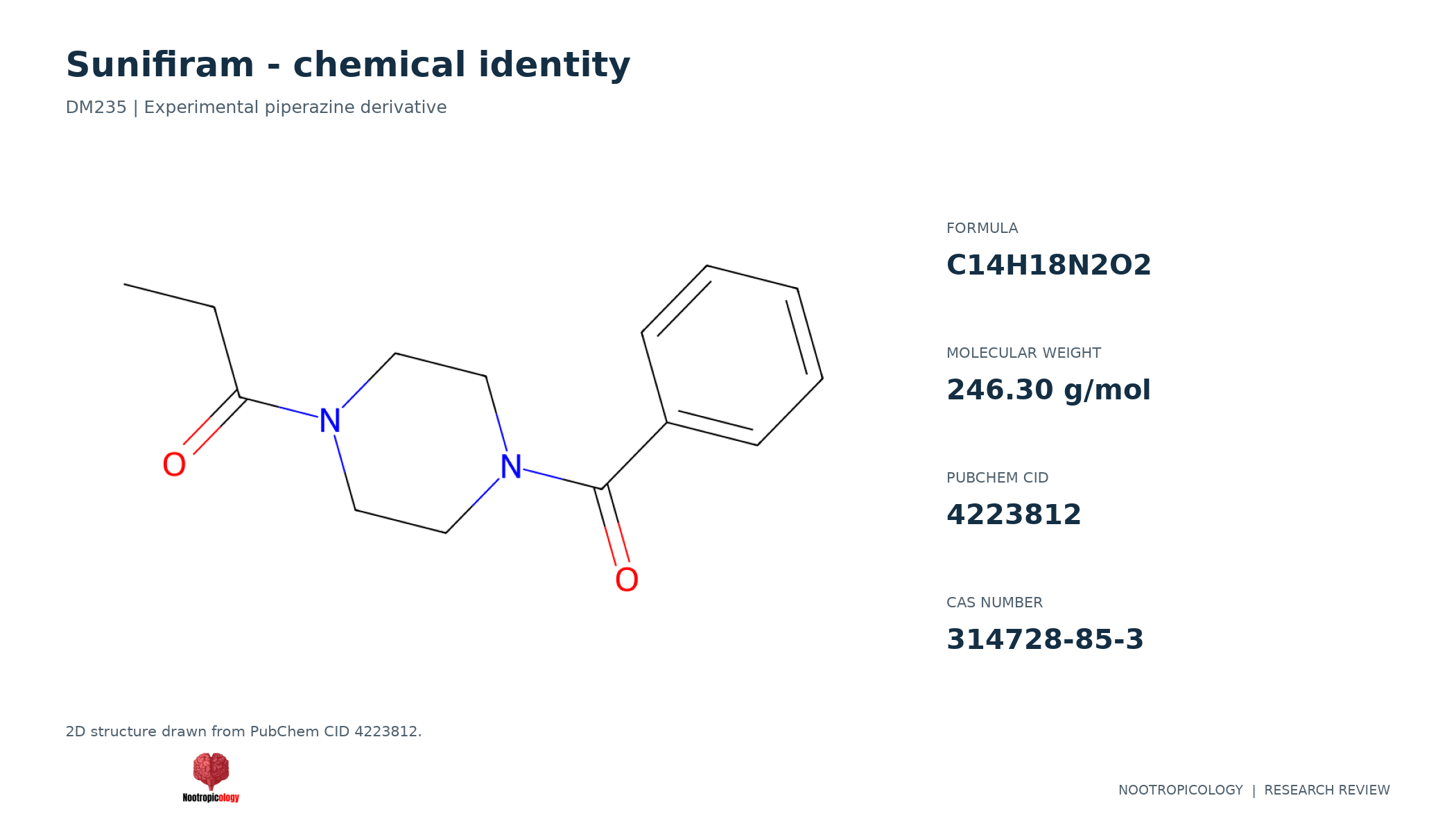
Sunifiram has a piperazine ring carrying benzoyl and propionyl groups. Its systematic name is 1-(4-benzoylpiperazin-1-yl)propan-1-one. Piracetam, by comparison, has a pyrrolidone-based structure. [4]
| Identifier | Value |
|---|---|
| Name | Sunifiram |
| Synonyms | DM235; DM-235; DM 235 |
| CAS number | 314728-85-3 |
| Molecular formula | C14H18N2O2 |
| Molecular weight | 246.30 g/mol |
| PubChem CID | 4223812 |
| InChIKey | DGOWDUFJCINDGI-UHFFFAOYSA-N |
| IUPAC name | 1-(4-benzoylpiperazin-1-yl)propan-1-one |
Sunifiram is designated DM235; the related research lead Unifiram is DM232. The compounds emerged from a medicinal-chemistry program investigating memory-related activity. [1]
Sunifiram's Origin in Medicinal Chemistry
The 2000 medicinal-chemistry paper investigated simplified piperazine derivatives of a more complex bicyclic series. DM235 was one of the resulting leads. Researchers compared structural changes with performance in a mouse passive-avoidance test, an approach known as a structure-activity relationship study. The paper also reported increased acetylcholine release in rat brain for the leading compounds. [1]
The starting series contained a fused bicyclic framework, 1,4-diazabicyclo[4.3.0]nonan-9-one. Simplifying that structure produced 4-substituted 1-acylpiperazines. Sunifiram retains two nitrogen atoms in its piperazine ring, with a benzoyl group attached to one and a propionyl group attached to the other. Its 246.30 g/mol molecular weight describes this specific molecule.
The medicinal-chemistry program used behavioral activity to compare the resulting derivatives. Compounds were evaluated in a mouse passive-avoidance procedure, and selected leads were examined for acetylcholine release in rat brain. That combination of structural modification and pharmacological testing explains why Sunifiram appears in both nootropic chemistry papers and later neurotransmission studies.[1]
How Does Sunifiram Work?
Sunifiram research focuses on glutamate signaling and synaptic plasticity. AMPA-related behavioral experiments and NMDA-related studies of long-term potentiation examine different parts of that proposed mechanism.
Sunifiram and AMPA Receptor Signaling
In a 2003 study, Sunifiram and Unifiram reversed NBQX-induced amnesia in mice. In a separate rat hippocampal-slice experiment, NBQX blocked their reversal of kynurenic-acid inhibition of NMDA-mediated neurotransmitter release. The authors implicated AMPA signaling in these responses. [5]
In the mouse experiment, the researchers administered NBQX at 30 mg/kg and tested each investigational compound at 0.1 mg/kg by intraperitoneal injection. Sunifiram reduced the memory impairment in the passive-avoidance task. The tissue experiment examined radiolabeled noradrenaline release from rat hippocampal slices during NMDA stimulation. Kynurenic acid inhibited that release, and Sunifiram reversed the inhibition; adding NBQX removed the reversal.[5]
Sunifiram, NMDA Signaling, and Long-Term Potentiation
A 2013 study examined long-term potentiation (LTP) in mouse hippocampal slices. Sunifiram enhanced LTP over a nanomolar concentration range, with a bell-shaped response and a reported maximum at 10 nM. The investigators implicated the glycine-binding site of NMDA receptors and signaling involving Src, CaMKII, and protein kinase C alpha. [3]
LTP is a persistent increase in synaptic response after stimulation. Researchers measured it through electrophysiological recordings in the hippocampal CA1 region.
The hippocampal study recorded field excitatory postsynaptic potentials, abbreviated fEPSPs. These electrical signals reflect the response of a population of neurons to stimulation. Researchers followed the slope of that response before and after an LTP-inducing stimulation protocol to quantify changes in synaptic strength.
Sunifiram affected two measurements differently. The enhancement of LTP followed a bell-shaped concentration-response curve, peaking at 10 nM. Basal fEPSP slope increased across the tested 1 to 1,000 nM range. The paper therefore separates changes in ordinary synaptic transmission from changes in the additional potentiation produced by the stimulation protocol.
Immunoblotting measured phosphorylation of proteins involved in the response. The investigators reported activation of CaMKII and PKC alpha, together with changes in AMPA and NMDA receptor phosphorylation. Src phosphorylation at Tyr416 and PKC alpha phosphorylation at Ser657 were greatest at 10 nM, matching the concentration associated with the strongest LTP effect.[3]
What Do the NMDA Blocker Experiments Show?
In the hippocampal-slice study, 7-chlorokynurenic acid blocked the LTP enhancement, whereas ifenprodil left it intact. PP2, an inhibitor of Src-family signaling, also blocked the enhancement. [3]
7-Chlorokynurenic acid targets the glycine-binding component of NMDA receptor signaling. Ifenprodil targets receptors containing the GluN2B subunit, historically called NR2B. Their different effects helped the investigators narrow the pathway involved in the slice response. PP2 addressed a further step by inhibiting Src-family kinases, proteins that regulate phosphorylation signaling.
The researchers also pretreated slices with 300 micromolar glycine. Under that condition, Sunifiram produced no additional LTP enhancement. Taken together, the blocker and glycine experiments were the basis for the paper's proposed involvement of the NMDA glycine-binding site and Src-dependent signaling.[3]
Sunifiram Benefits in Animal Studies
Ghelardini and colleagues reported that Sunifiram reduced experimentally induced amnesia in mice and scopolamine-related spatial-memory impairment in rats. At the highest effective exposures, motor coordination and spontaneous activity remained unchanged. [2]
In olfactory-bulbectomized mice, Sunifiram improved Y-maze and novel-object recognition performance. The tail-suspension test showed no improvement in depressive-like behavior. [6]
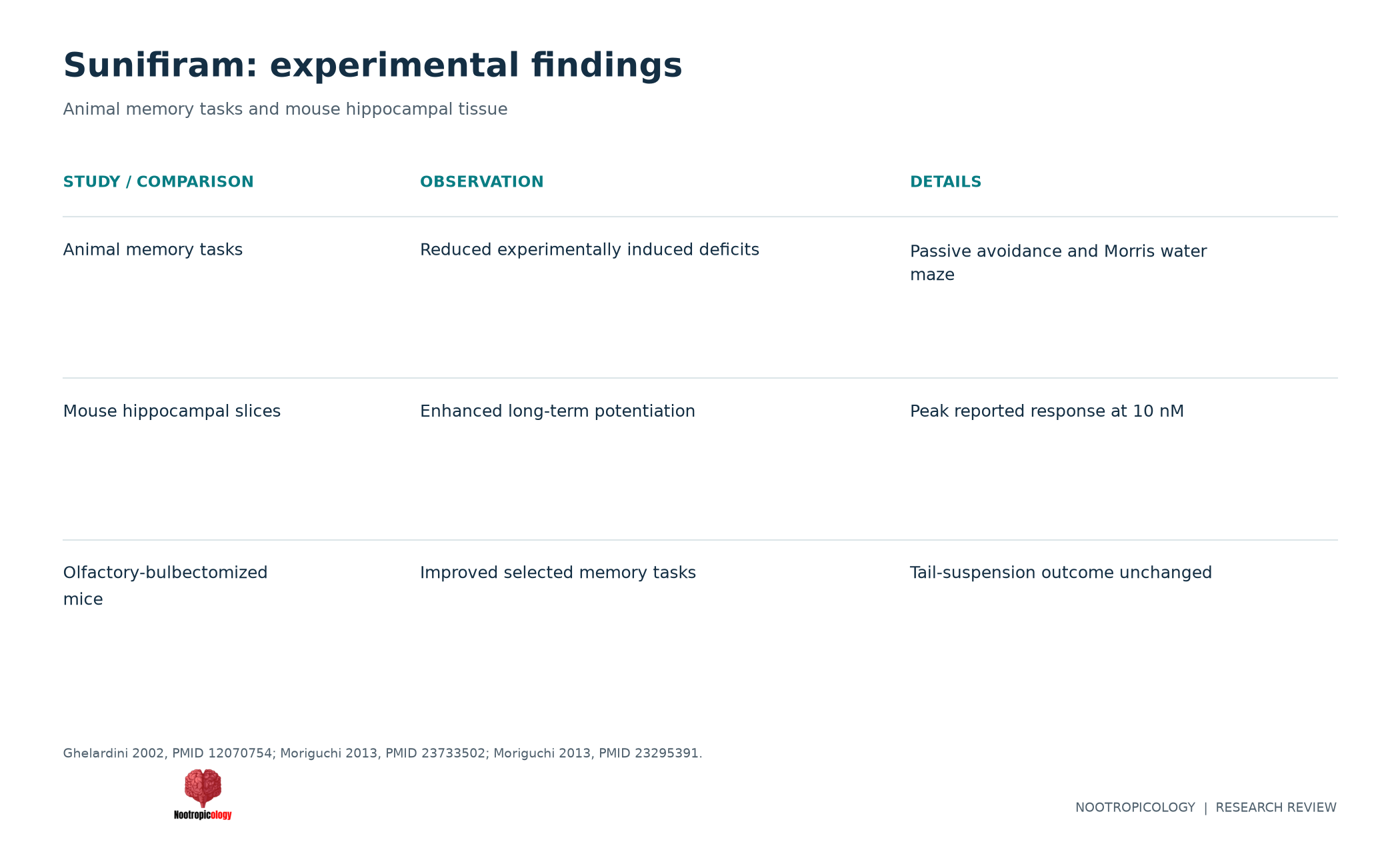
The 2002 mouse experiments used several agents to impair memory. Scopolamine interferes with muscarinic acetylcholine signaling; mecamylamine blocks nicotinic acetylcholine receptors. Baclofen acts through GABA-B receptors, while clonidine acts at alpha-2 adrenergic receptors. Sunifiram prevented amnesia caused by each agent in the passive-avoidance procedure.
For scopolamine-induced impairment, reported active Sunifiram ranges were 0.001 to 0.1 mg/kg by intraperitoneal injection and 0.01 to 0.1 mg/kg orally. In the rat water-maze experiment, 0.1 mg/kg was administered 20 minutes before each daily acquisition session. Treated rats showed better escape performance during both learning and retention or retraining tests.[2]
Which Memory Tasks Were Used in Sunifiram Research?
Passive avoidance examines learned avoidance of an unpleasant experience. The Morris water maze measures spatial learning through escape performance. Novel-object recognition compares exploration of familiar and unfamiliar objects.
| Experiment | Task | Reported result |
|---|---|---|
| Induced amnesia in mice | Passive avoidance | Reduced impairment caused by scopolamine and other experimental agents. |
| Scopolamine-treated rats | Morris water maze | Improved escape performance during learning and retention testing. |
| Olfactory-bulbectomized mice | Y-maze, novel-object recognition, tail suspension | Improved memory-task performance; unchanged depressive-like behavior. |
The early study also assessed motor coordination with the rota-rod test and measured spontaneous activity using Animex and hole-board procedures. [2]
In passive avoidance, investigators measure how long an animal waits before entering a location previously associated with an aversive event. In the Morris water maze, the animal learns the location of an escape platform using spatial cues. The Sunifiram experiment tracked the reduction in escape latency across sessions, which scopolamine otherwise disrupted.
The 2013 olfactory-bulbectomy study added Y-maze and novel-object recognition testing. Sunifiram was administered orally once daily for 7 to 12 days, starting 10 days after surgery. The tested range was 0.01 to 1 mg/kg. Improvements in these memory tasks accompanied restoration of hippocampal LTP, while the tail-suspension behavioral result remained negative.[6]
Sunifiram and Hippocampal Kinase Activity
The same study examined specific phosphorylation sites in hippocampal CA1 tissue. Sunifiram restored CaMKII alpha Thr286 and the AMPA-receptor subunit GluR1 Ser831 toward control levels. It also restored PKC alpha Ser657 and the NMDA-receptor subunit NR1 Ser896. CaMKIV Thr196 and ERK phosphorylation were unchanged.
Pretreatment with gavestinel, another inhibitor acting at the NMDA glycine-binding site, blocked the kinase responses and the restoration of LTP. These biochemical measurements link the behavioral experiments with the separate hippocampal-slice investigation published that year.[6]
Sunifiram vs. Piracetam: Experimental Potency
The often-quoted potency comparison comes from animal experiments. In the 2002 study, Sunifiram prevented scopolamine-induced amnesia at lower administered amounts than piracetam in the mouse passive-avoidance test. Potency here refers to the exposure producing that experimental effect. [2]
Our piracetam review covers its chemical identity and cognitive research.
The 2002 study compared the antiamnesic response with piracetam at 30 to 100 mg/kg by intraperitoneal injection and aniracetam at 100 mg/kg orally. Sunifiram reached activity at much lower administered amounts in that experimental setup. The paper's often-repeated potency comparison refers to these animal task results and the amounts required to obtain them.
Chemically, Sunifiram's piperazine ring differs from the pyrrolidone framework associated with piracetam. The related name Unifiram refers to DM232, another lead examined alongside DM235 in the AMPA study. Keeping the development codes attached to each name helps distinguish results from papers that tested both molecules.[2]
Sunifiram Dosage, Half-Life, and Human Research
The reviewed Sunifiram studies used animals or isolated tissue. Human therapeutic dosage and elimination half-life remain uncharacterized.
Sunifiram Concentrations and Experimental Conditions
The tissue experiments report concentration in nanomoles per liter. Animal studies report administered mass per kilogram of body weight. The original papers also specify oral or injected administration and the interval between treatment and behavioral testing.
Nanomolar concentration specifies the number of molecules present in a volume of experimental solution. For example, 10 nM equals 0.01 micromolar. In the hippocampal-slice experiment, researchers could directly control the concentration bathing the tissue and measure an electrical response as it changed. The peak LTP response and basal-transmission measurements were recorded in this setting.
The whole-animal experiments expressed exposure as milligrams per kilogram of body weight and specified the administration route. Oral treatment was used in the olfactory-bulbectomy study, while several early amnesia experiments used intraperitoneal injection. The published methods also recorded treatment timing relative to training or surgery. Those details explain why the Sunifiram literature contains several different numerical ranges.[3]
Sunifiram Side Effects and Safety
Motor coordination and spontaneous activity remained unchanged at the effective exposures in the early rodent experiments. Human adverse-event frequencies and long-term tolerability remain uncharacterized in the reviewed literature.
Our Alpha-GPC review separately covers a choline source often discussed in nootropic combinations.
A later paper on synthesized Sunifiram-carbamate hybrid molecules was retracted. Its findings are excluded from this review's evidence summary. [7]
One additional observation in the 2002 experiments concerned pentobarbital-induced sleep. At 1 mg/kg by intraperitoneal injection, Sunifiram shortened the duration of hypnosis without changing its onset. The motor-control experiments used rota-rod performance, while spontaneous movement and exploratory behavior were measured with Animex and hole-board procedures. Those measurements remained unchanged at the highest effective doses used for the memory experiments.[2]
The animal studies separated task performance from general movement by measuring both. Rota-rod testing assessed whether mice could maintain coordinated movement on a rotating apparatus. Hole-board observations recorded exploratory activity, and Animex measurements tracked spontaneous movement. The absence of changes on these measures was part of the original authors' assessment of the behavioral effects at the tested exposures.
The later olfactory-bulbectomy experiment likewise produced a selective behavioral pattern: memory-related tasks improved, while the tail-suspension result stayed unchanged. The published observations are therefore organized by the specific behavior and experimental model.[2][6]
Sunifiram User Experiences and Reddit Reviews
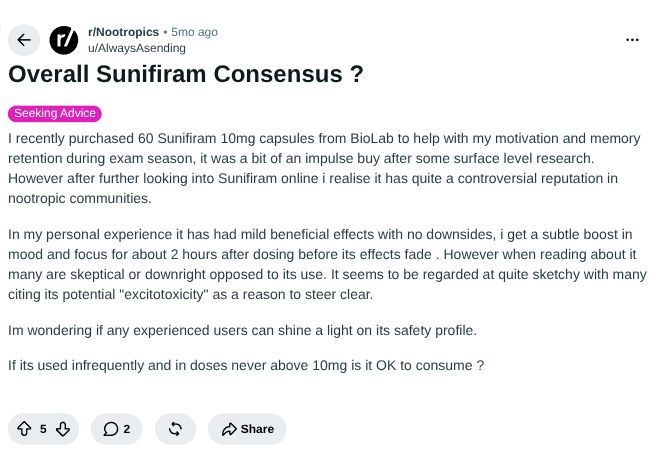
A June 2026 r/Nootropics discussion began with a user describing a mild improvement in mood and focus lasting about 2 hours. Despite reporting no downsides personally, the poster was concerned by conflicting safety claims elsewhere in the community. [8]
A respondent preferred Sunifiram to Unifiram and described vivid mental imagery.
Where to Buy Sunifiram: Swisschems Powder Details
Swisschems lists Sunifiram as a 10 g research powder.
Sunifiram Review Conclusion
Sunifiram's preclinical record includes reduced induced amnesia, improved performance in selected rodent memory tasks, and enhanced hippocampal LTP. The mechanistic studies implicate AMPA and NMDA signaling, with findings involving Src, CaMKII, and PKC alpha.
Our Noopept review examines another experimental compound studied for memory-related effects.
Frequently Asked Questions About Sunifiram
Common Sunifiram questions concern its chemical class, experimental potency, mechanism, and safety data.
What Is Sunifiram Used For?
Sunifiram is used in experimental research on memory and synaptic plasticity. Studies of the compound, also called DM235, include rodent memory tasks and hippocampal-tissue experiments. An effective human treatment dose has not been established.
Is Sunifiram the Most Powerful Nootropic?
Sunifiram has not been established as the most powerful nootropic in humans. The commonly quoted potency claim comes from preclinical dose comparisons with piracetam. Activity at a lower dose in an animal experiment does not establish greater cognitive benefit in people.
What Is the Difference Between Sunifiram and Piracetam?
The difference between Sunifiram and Piracetam is their chemical structure and the evidence available for their effects. Sunifiram is a piperazine derivative with benzoyl and propionyl groups, while piracetam has a pyrrolidone-based structure. Comparisons cited for Sunifiram come from experimental memory tasks, rather than head-to-head human trials.
What Is the Mechanism of Action of Sunifiram?
The proposed mechanism of action of Sunifiram involves AMPA and NMDA signaling in preclinical experiments. Hippocampal studies found enhanced long-term potentiation, a sustained strengthening of communication between neurons. Researchers also measured changes involving Src, CaMKII, and protein kinase C alpha.
What Are the Downsides of Taking Sunifiram?
The main downside of taking Sunifiram is the lack of established human safety and dosing data. Human adverse-event rates and long-term tolerability remain uncharacterized. Early rodent studies found unchanged motor coordination and spontaneous activity at the tested effective exposures.
- Manetti, D et al. "Molecular simplification of 1,4-diazabicyclo[4.3.0]nonan-9-ones gives piperazine derivatives that maintain high nootropic activity." Journal of medicinal chemistry vol. 43,23 (2000): 4499-507. doi:10.1021/jm000972h. ↑ ↑ ↑ ↑
- Ghelardini, C et al. "DM235 (sunifiram): a novel nootropic with potential as a cognitive enhancer." Naunyn-Schmiedeberg's archives of pharmacology vol. 365,6 (2002): 419-26. doi:10.1007/s00210-002-0577-3. ↑ ↑ ↑ ↑ ↑ ↑ ↑ ↑
- Moriguchi, Shigeki et al. "Novel nootropic drug sunifiram enhances hippocampal synaptic efficacy via glycine-binding site of N-methyl-D-aspartate receptor." Hippocampus vol. 23,10 (2013): 942-51. doi:10.1002/hipo.22150. ↑ ↑ ↑ ↑ ↑ ↑
- National Center for Biotechnology Information. "PubChem Compound Summary for CID 4223812, Sunifiram." PubChem (accessed 6 Nov. 2026). ↑
- Galeotti, N et al. "AMPA-receptor activation is involved in the antiamnesic effect of DM 232 (unifiram) and DM 235 (sunifiram)." Naunyn-Schmiedeberg's archives of pharmacology vol. 368,6 (2003): 538-45. doi:10.1007/s00210-003-0812-6. ↑ ↑
- Moriguchi, Shigeki et al. "Novel nootropic drug sunifiram improves cognitive deficits via CaM kinase II and protein kinase C activation in olfactory bulbectomized mice." Behavioural brain research vol. 242 (2013): 150-7. doi:10.1016/j.bbr.2012.12.054. ↑ ↑ ↑ ↑
- "Statement of Retraction: Novel Sunifiram carbamate hybrids as potential dual acetylcholinesterase inhibitor and NMDAR co-agonist simulation-guided analogue design and pharmacological screening." Journal of enzyme inhibition and medicinal chemistry vol. 41,1 (2026): 2712703. doi:10.1080/14756366.2026.2712703. ↑
- Reddit contributors. "Overall Sunifiram Consensus?." r/Nootropics (4 June 2026). ↑