
PQQ Review: Disodium Salt, Memory Trials, and Mitochondria
PQQ disodium is a salt of pyrroloquinoline quinone, a redox-active compound studied for mitochondrial signaling and cognitive function. Small randomized trials have reported improvements in selected memory and attention measures. Cell experiments have examined its effects on mitochondrial biogenesis through CREB and PGC-1alpha signaling. [1][2][3][4]
What Is PQQ Disodium and Its Chemical Composition?
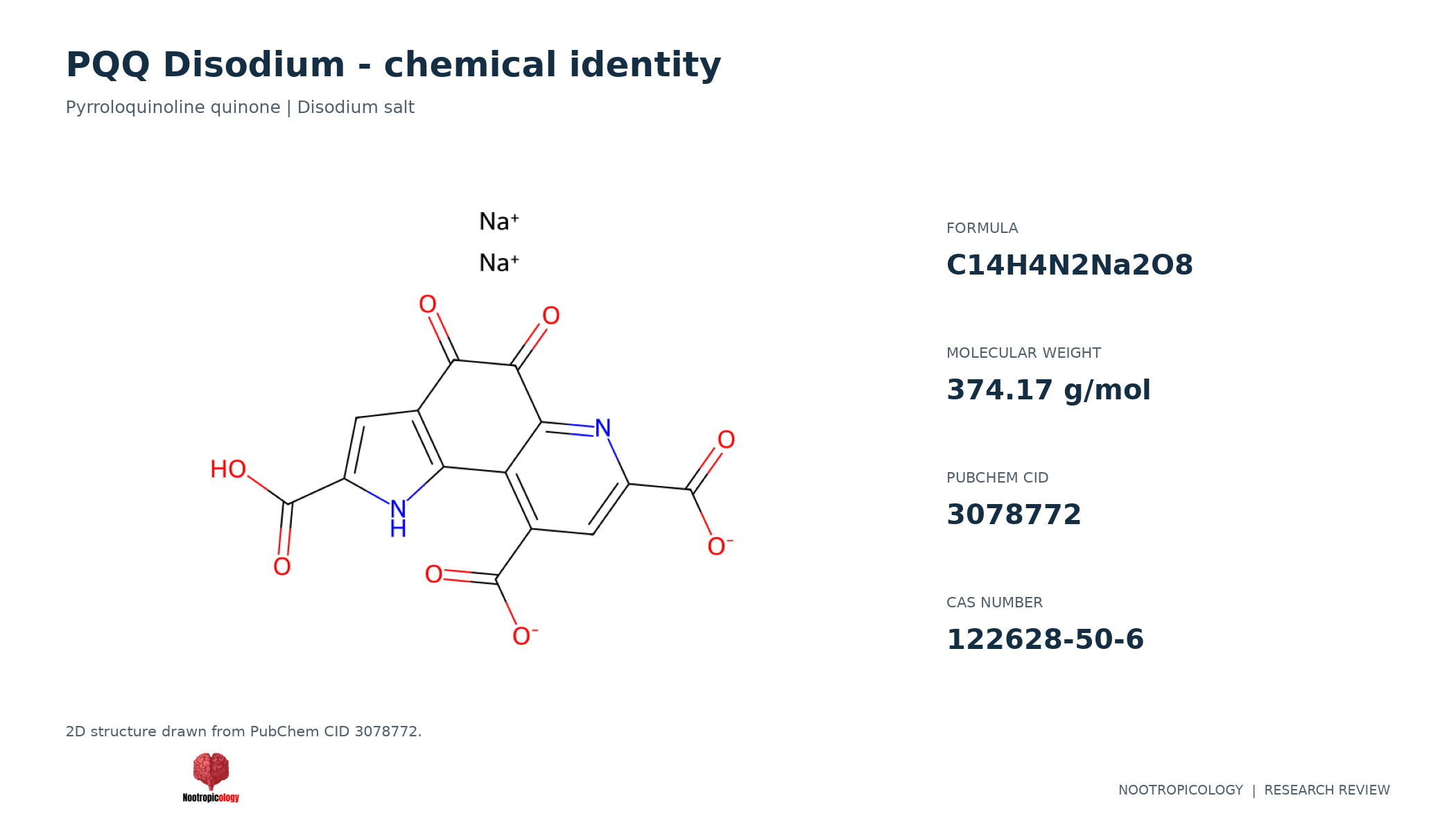
PQQ stands for pyrroloquinoline quinone, also known as methoxatin. The disodium salt contains 2 sodium ions and has a molecular weight of 374.17 g/mol, compared with 330.21 g/mol for the parent acid. [5][6]
| Identifier | Value |
|---|---|
| Name | Pyrroloquinoline quinone disodium salt |
| Synonyms | Methoxatin disodium; PQQ-2Na; PQQ disodium salt |
| CAS number | 122628-50-6 |
| Molecular formula | C14H4N2Na2O8 |
| Molecular weight | 374.17 g/mol |
| PubChem CID | 3078772 |
| InChIKey | UFVBOGYDCJNLPM-UHFFFAOYSA-L |
| IUPAC name | disodium;2-carboxy-4,5-dioxo-1H-pyrrolo[2,3-f]quinoline-7,9-dicarboxylate |
PQQ and coenzyme Q10 have distinct chemical structures. PQQ is also called methoxatin; coenzyme Q10 belongs to the ubiquinone family.
The disodium designation describes the salt form, with two sodium ions replacing two acidic hydrogens in the parent structure. The published molecular weight of anhydrous PQQ disodium is 374.17 g/mol, compared with approximately 330.21 g/mol for the free acid. The salt and free acid therefore have separate identifiers even though both names refer to the PQQ chemical system.
Methoxatin is an alternative name for PQQ. Its quinone structure participates in oxidation-reduction chemistry, the transfer of electrons between molecules. This chemistry is part of the background to research on antioxidant activity and cellular metabolism. The mitochondrial studies also examine signaling proteins and gene expression, giving the research a broader focus than direct radical scavenging alone.[1]
How Does PQQ Affect Mitochondria?
Chowanadisai and colleagues exposed mouse Hepa1-6 cells to PQQ and measured markers of mitochondrial biogenesis. They found changes in mitochondrial DNA content, enzyme activity, oxygen respiration, and signaling associated with CREB and PGC-1alpha. Reducing CREB or PGC-1alpha expression prevented the biogenesis response in that experimental system. [1]
The measured pathway included nuclear respiratory factors and TFAM, a gene involved in mitochondrial transcription. The experiments used mouse liver-derived Hepa1-6 cells. [1]
Mitochondrial biogenesis involves producing and maintaining mitochondrial components. The study tracked it using mitochondrial DNA content, enzyme activity, oxygen respiration, and changes in gene expression.
Chowanadisai and colleagues exposed Hepa1-6 cells to 10 to 30 micromolar PQQ for 24 to 48 hours. Citrate synthase and cytochrome c oxidase activities increased, alongside mitochondrial DNA content, MitoTracker staining, and oxygen consumption. Using several measurements let the researchers track changes in mitochondrial components as well as respiratory activity.
PQQ Mitochondrial Signaling and Gene Expression
The signaling sequence began with increased phosphorylation of CREB at serine 133. CREB stands for cAMP response element-binding protein, a transcription factor that helps regulate gene expression. The investigators observed activation of the PGC-1alpha promoter and increases in both its messenger RNA and protein. PGC-1alpha is a coactivator involved in coordinating mitochondrial biogenesis.
Small interfering RNA was used to reduce either CREB or PGC-1alpha expression. Under either condition, PQQ no longer stimulated the measured biogenesis response. The downstream results included increased nuclear respiratory factor activity and increased expression of mitochondrial transcription-related genes TFAM, TFB1M, and TFB2M.
The same experiments tested several inhibitors of mitochondrial function, including rotenone, 3-nitropropionic acid, antimycin A, and sodium azide. PQQ protected cells against the mitochondrial inhibition produced by these agents. The study therefore examined both production of mitochondrial components and responses to experimentally disrupted respiration.[1]
PQQ Benefits in Human Cognitive Studies
Two 12-week randomized trials examined PQQ using standardized cognitive assessments. Their reported results included composite memory, verbal memory, and selected attention measures.
PQQ Memory Study in Older Adults
Shiojima and colleagues randomized 64 volunteers to PQQ disodium or placebo for 12 weeks. The trial used 21.5 mg/day of the tested PQQ disodium preparation. Of the 58 completers, 27 received PQQ and 31 received placebo. Results favored PQQ on several Cognitrax domains, including composite memory, verbal memory, reaction time, complex attention, cognitive flexibility, executive function, and motor speed. [2]
A published correction updates Table 4 of the study. [7]
Cognitrax divides performance into separate domains rather than reporting only a single global score. Composite memory combines memory-related performance, while verbal memory focuses on verbally presented information. Reaction time and motor speed address response timing. Complex attention, cognitive flexibility, and executive function capture additional aspects of task performance.
The study's completion figures were unequal between groups: 27 in the active group and 31 in the placebo group. The reported results therefore describe the participants who completed the assessment schedule. Alongside the cognitive findings, the researchers recorded tolerability over the 12-week intervention and reported no adverse events.[2]
PQQ Memory Study in Younger and Older Adults
Tamakoshi and colleagues studied adults aged 20 to 65 using 20 mg/day of PQQ for 12 weeks. The full-sample results favored PQQ on composite and verbal memory. In the age-stratified analysis, younger adults showed changes in cognitive flexibility, processing speed, and execution speed at 8 weeks; older adults showed memory improvements at 12 weeks. [3]
The age-stratified analysis divided participants into groups aged 20 to 40 and 41 to 65. In the younger group, the authors highlighted changes in cognitive flexibility, processing speed, and execution speed at the 8-week assessment. In the older group, the reported improvements at 12 weeks concerned composite and verbal memory.
The timing gives the results more detail than a general claim of improved brain function. The study collected cognitive outcomes over a 12-week course and analyzed both the full sample and the two age groups. Its full-sample memory findings provide the broadest participant comparison, with the subgroup analyses showing the pattern reported at specific ages and assessment points.[3]
PQQ Cognitive Assessments
The older-adult study used Cognitrax as its primary cognitive assessment. Secondary measures included the DECO forgetfulness questionnaire and the Japanese Mini-Mental State Examination (MMSE-J). The authors reported favorable results on both secondary measures. [2]
Six of the 64 randomized participants did not complete the study, a dropout proportion of 9.4%.
The primary cognitive battery and secondary questionnaires captured different types of information. Cognitrax recorded performance during standardized tasks. The DECO questionnaire addressed everyday forgetfulness, while MMSE-J supplied a broader cognitive screening score. Reporting the instrument beside each result makes it possible to distinguish a change in task performance from a change in questionnaire responses.
The two 12-week studies also used different participant groupings. Shiojima's trial reported 58 completers after randomizing 64 volunteers. Tamakoshi's analysis covered adults from 20 to 65 and included age-stratified results. These study characteristics are useful when comparing the memory findings with the separate 6-week trial in older adults with mild cognitive impairment, which used a combination preparation and a blood biomarker as its primary endpoint.[2][3]
PQQ and Dihydrogen: What Did the Clinical Trial Find?
A 2024 trial randomized 34 older adults with mild cognitive impairment to a dihydrogen-PQQ mixture or placebo for 6 weeks. Its primary endpoint was serum brain-derived neurotrophic factor (BDNF). BDNF increased within the treatment group (p = 0.01); the treatment-by-time comparison was nonsignificant (p = 0.14). [4]
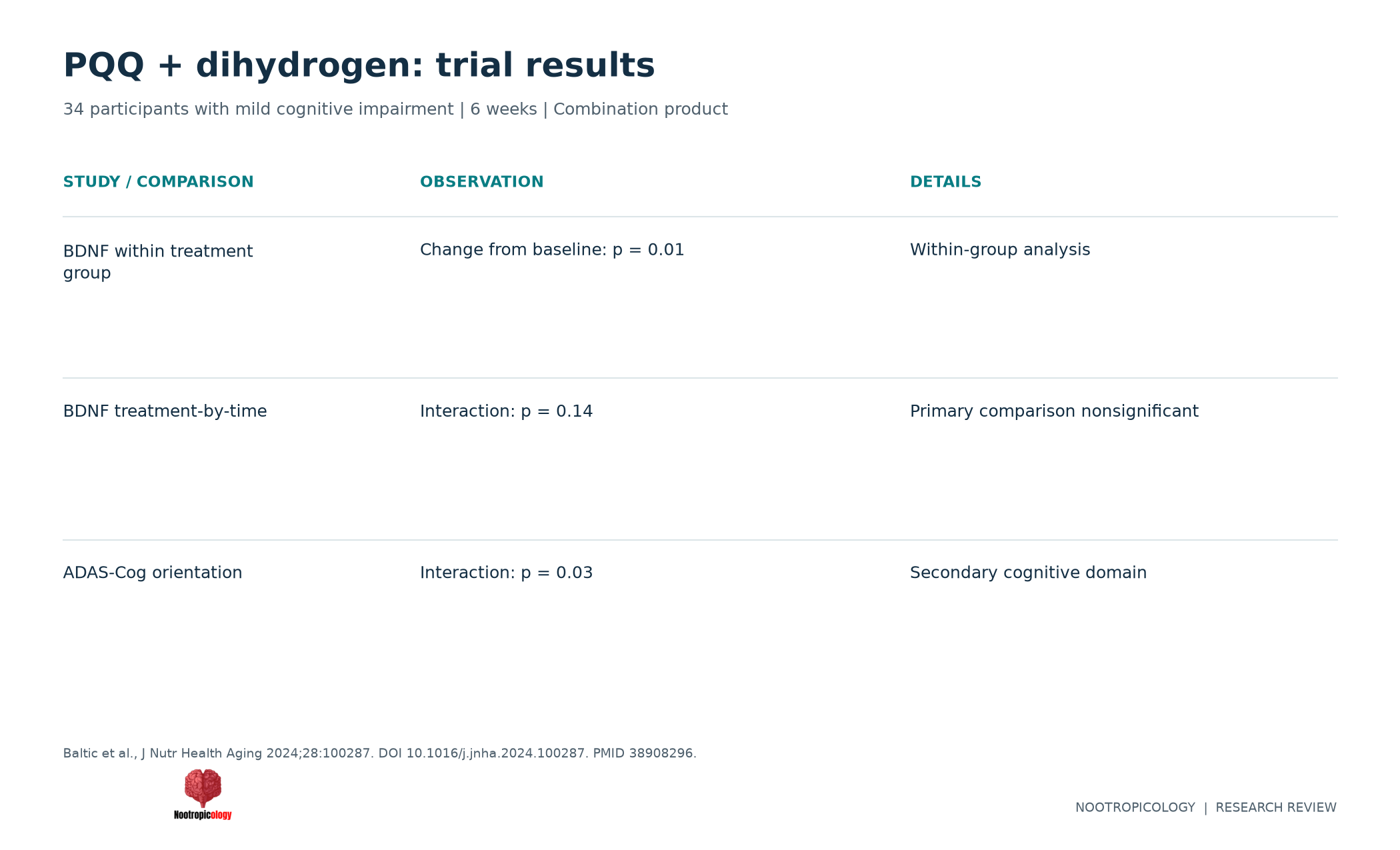
The combination produced a significant treatment-by-time interaction in the orientation domain of the Alzheimer's Disease Assessment Scale-Cognitive subscale (ADAS-Cog), with p = 0.03. The intervention contained both dihydrogen-producing minerals and PQQ. [4]
Participants had a mean age of 71.9 years, and 28 of the 34 were women. Eighteen were assigned to the experimental preparation and 16 to the control group. The investigators measured cognition, blood biomarkers, and brain-related physiological outcomes at baseline and after 6 weeks. The preparation was taken twice daily.
The Mini-Mental State Examination provided a general cognitive screen, while ADAS-Cog examined separate domains including orientation. The reported orientation improvement was approximately 22.2% in the experimental group, with the significant treatment-by-time comparison noted above. Baseline BDNF concentrations differed substantially between groups: approximately 20.9 ng/mL in the experimental group and 8.1 ng/mL in controls.
Functional near-infrared spectroscopy measured oxygenation over the prefrontal cortex. Within the experimental group, cerebral oxygen saturation rose from 48.4% to 52.8%. Magnetic resonance spectroscopy in a subset measured N-acetylaspartate, total choline, and total creatine. N-acetylaspartate increased at 7 of the 13 assessed brain locations in the before-and-after analysis.[4]
PQQ Research: Comparing Cell Experiments and Human Trials
| Study model | Measurements | Reported finding |
|---|---|---|
| Mouse Hepa1-6 cells | Mitochondrial DNA, enzymes, respiration, CREB and PGC-1alpha | Increased markers of mitochondrial biogenesis. |
| 12-week PQQ trials | Cognitive tasks and questionnaires | Favorable results in selected memory and attention domains. |
| 6-week dihydrogen-PQQ trial | Serum BDNF and ADAS-Cog | Nonsignificant BDNF interaction; significant orientation-domain result. |
The research spans cellular mitochondrial markers, standardized cognitive tests, and blood biomarkers. The studies differ in population, treatment duration, and preparation.
Our Bacopa monnieri review covers another supplement investigated in human memory studies.
PQQ and Inflammatory Biomarkers
Harris and colleagues studied 10 adults, equally divided between women and men, in two short crossover experiments. One used a single 0.2 mg/kg dose and tracked blood and urinary PQQ measurements over 48 hours. The other used 0.3 mg/kg daily, with measurements after 76 hours.
The repeated-dose experiment reported reductions in plasma C-reactive protein and interleukin-6, two inflammatory markers. Urinary measurements showed lower methylated amines, including trimethylamine N-oxide, and other changes in metabolites associated with oxidative metabolism. Standard clinical measures, including glucose and blood lipids, remained normal and unchanged. This study adds human blood and urine measurements to the cognitive and cell-culture research.[8]
PQQ Dosage and Supplement Forms
The cognitive trials used daily PQQ preparations for 12 weeks: 21.5 mg/day in Shiojima's study and 20 mg/day in Tamakoshi's study. [2][3]
The European Union's 2018 novel-food authorization specified PQQ disodium in adult food supplements at 20 mg/day, excluding pregnant and lactating women. [9]
PQQ Side Effects and Safety
Shiojima and colleagues reported no adverse events during their 12-week study. EFSA also reviewed human safety observations, animal toxicology, and genotoxicity testing in its ingredient assessment. [2]
In the 6-week combination trial, participants who completed the study reported no significant adverse events. One control-group participant reported mild, temporary heartburn, and two described an excessively sweet taste. Four women in the experimental group reported better well-being, less fatigue, or improvements in energy and sleep. Adherence was approximately 97% in the experimental group and 96% in controls.[4]
What Did EFSA Conclude About PQQ Safety?
EFSA concluded that the specified PQQ disodium ingredient was safe under the proposed conditions of use. The assessment noted that the human studies included limited evaluation of kidney function. [10]
PQQ User Experiences and Reddit Reviews
In the r/Supplements thread "PQQ feels amazing?", the original poster described a rapid increase in perceived energy. Other participants said they noticed no effect after repeated use, while another reported worse sleep. [11]

Where to Buy PQQ Disodium: Swisschems Product Details
Swisschems lists PQQ disodium as a 1 g research powder.
PQQ Review Conclusion
PQQ has both mechanistic research on mitochondrial biogenesis and small randomized cognitive trials. The 12-week studies reported favorable memory outcomes. In the 6-week dihydrogen-PQQ trial, the primary BDNF comparison was nonsignificant, while the secondary orientation outcome favored the combination.
Our nootropics comparison covers other compounds studied for memory and attention.
Frequently Asked Questions About PQQ
Common PQQ questions concern daily use, CoQ10, cognitive benefits, and reported adverse effects.
What Is a PQQ Supplement Used For?
A PQQ supplement is used for cognitive and mitochondrial support, the purposes for which it is commonly marketed. Human trials have examined memory and attention over several weeks. Cell studies have investigated mitochondrial biogenesis, the production of additional mitochondrial components.
Is PQQ the Same as CoQ10?
PQQ is not the same as CoQ10. PQQ is pyrroloquinoline quinone, also called methoxatin, while CoQ10 is coenzyme Q10, a ubiquinone. They are chemically distinct compounds, so evidence for one cannot be treated as evidence for the other.
Can I Take PQQ Every Day?
PQQ has been taken daily in human studies lasting 12 weeks. Tamakoshi and colleagues studied 20 mg per day, while Shiojima and colleagues used 21.5 mg per day of their tested PQQ disodium preparation. These studies provide short-term daily-use data, not an established safety record for indefinite use.
Who Should Not Take PQQ?
Children and pregnant or breastfeeding women are excluded from the adult use specified in the cited EU authorization for PQQ disodium supplements. The authorization sets a maximum intake of 20 mg per day for the permitted adult use. It does not establish suitability for every adult with an existing medical condition.
What Are the Negative Effects of Taking PQQ Supplements?
The negative effects of PQQ supplements are not well characterized across different users and durations. Shiojima and colleagues reported no adverse events in their 12-week trial. The Reddit discussion reviewed here includes a report of worse sleep, but that anecdote cannot establish how often the effect occurs.
- Chowanadisai, Winyoo et al. "Pyrroloquinoline quinone stimulates mitochondrial biogenesis through cAMP response element-binding protein phosphorylation and increased PGC-1alpha expression." The Journal of biological chemistry vol. 285,1 (2010): 142. doi:10.1074/jbc.M109.030130. ↑ ↑ ↑ ↑ ↑
- Shiojima, Yoshiaki et al. "Effect of Dietary Pyrroloquinoline Quinone Disodium Salt on Cognitive Function in Healthy Volunteers: A Randomized, Double-Blind, Placebo-Controlled, Parallel-Group Study." Journal of the American Nutrition Association vol. 41,8 (2022): 796. doi:10.1080/07315724.2021.1962770. ↑ ↑ ↑ ↑ ↑ ↑ ↑
- Tamakoshi, Masanori et al. "Pyrroloquinoline quinone disodium salt improves brain function in both younger and older adults." Food & function vol. 14,5 (2023): 2496. doi:10.1039/d2fo01515c. ↑ ↑ ↑ ↑ ↑
- Baltic, Sonja et al. "The impact of six-week dihydrogen-pyrroloquinoline quinone supplementation on mitochondrial biomarkers, brain metabolism, and cognition in elderly individuals with mild cognitive impairment: a randomized controlled trial." The journal of nutrition, health & aging vol. 28,8 (2024): 100287. doi:10.1016/j.jnha.2024.100287. ↑ ↑ ↑ ↑ ↑
- National Center for Biotechnology Information. "PubChem Compound Summary for CID 3078772, Pyrroloquinoline quinone disodium salt." PubChem (accessed 6 Nov. 2026). ↑
- National Center for Biotechnology Information. "PubChem Compound Summary for CID 1024, Pyrroloquinoline quinone." PubChem (accessed 6 Nov. 2026). ↑
- "Notice of Correction." Journal of the American Nutrition Association vol. 41,8 (2022): 855. doi:10.1080/27697061.2022.2099711. ↑
- Harris, Calliandra B, et al. "Dietary pyrroloquinoline quinone (PQQ) alters indicators of inflammation and mitochondrial-related metabolism in human subjects." The Journal of Nutritional Biochemistry vol. 24,12 (2013): 2076-2084. doi:10.1016/j.jnutbio.2013.07.008. ↑
- European Commission. "Commission Implementing Regulation (EU) 2018/1122." Official Journal of the European Union (2018). ↑
- EFSA Panel on Dietetic Products, Nutrition and Allergies. "Safety of pyrroloquinoline quinone disodium salt as a novel food pursuant to Regulation (EC) No 258/97." EFSA Journal vol. 15,11 (2017): 5058. doi:10.2903/j.efsa.2017.5058. ↑
- Reddit contributors. "PQQ feels amazing?." r/Supplements (accessed 6 Nov. 2026). ↑