
Eutropoflavin Review: 4'-DMA-7,8-DHF and TrkB Evidence
Eutropoflavin is 4'-dimethylamino-7,8-dihydroxyflavone, usually shortened to 4'-DMA-7,8-DHF. It is a synthetic flavone studied for neurotrophic signaling, cell survival, and behavior in mice. Early experiments reported TrkB-related activity; a later assessment obtained negative receptor-binding and functional results. [1][2][3]
What Is Eutropoflavin and Its Chemical Composition?
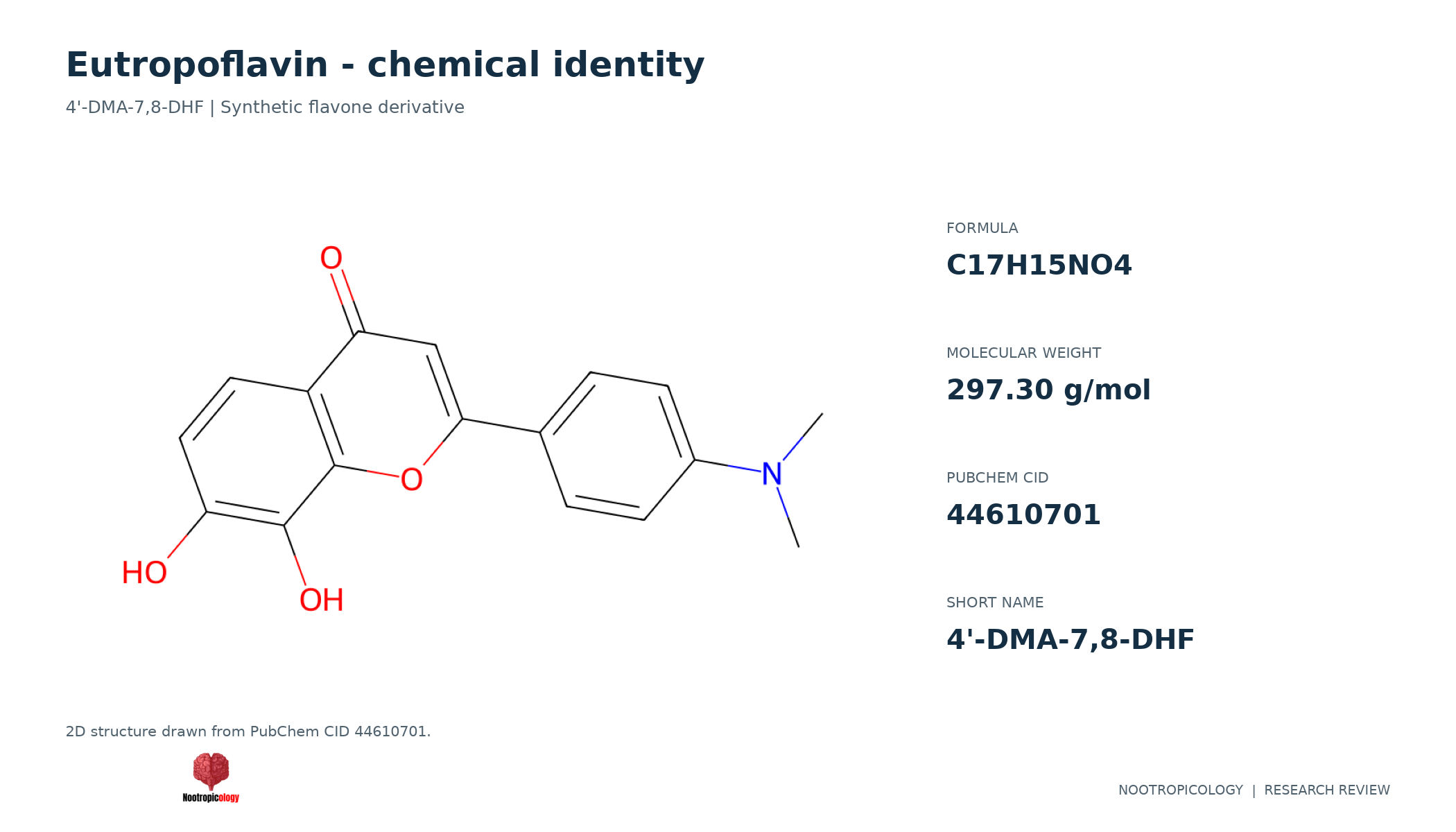
Eutropoflavin belongs to the flavone family. It has hydroxyl groups at positions 7 and 8 and a dimethylamino group at the 4' position. That additional dimethylamino group distinguishes it from 7,8-dihydroxyflavone. [1]
| Identifier | Value |
|---|---|
| Name | Eutropoflavin |
| Synonyms | 4'-DMA-7,8-DHF; 4'-dimethylamino-7,8-dihydroxyflavone |
| Molecular formula | C17H15NO4 |
| Molecular weight | 297.30 g/mol |
| PubChem CID | 44610701 |
| InChIKey | YPAYCZOHGRSGJS-UHFFFAOYSA-N |
| IUPAC name | 2-[4-(dimethylamino)phenyl]-7,8-dihydroxychromen-4-one |
The 7 and 8 positions belong to the flavone A ring. Their neighboring hydroxyl groups form a catechol arrangement. The prime mark in 4' identifies a position on the separate phenyl B ring, where Eutropoflavin carries its dimethylamino substituent. The central oxygen-containing C ring completes the flavone framework.
These positions were central to the original medicinal-chemistry work. Researchers compared hydroxyl, methoxy, fluoro, and nitrogen-containing substitutions to see how changes in structure affected signaling. Eutropoflavin was identified as compound 6 in that derivative series. Searching the full chemical name or 4'-DMA-7,8-DHF retrieves the experimental literature more precisely than using the commercial name alone.[2]
How Does Eutropoflavin Affect TrkB and BDNF Signaling?
TrkB is the receptor encoded by NTRK2. Its natural ligand, brain-derived neurotrophic factor (BDNF), participates in neuronal survival and synaptic signaling. Eutropoflavin research has examined small-molecule activity within this pathway. [3]
The original 2010 study identified 4'-DMA-7,8-DHF during a structure-activity investigation. The authors reported stronger or more sustained TrkB-related effects than with the parent compound in their experimental systems, alongside antiapoptotic findings. Chronic oral administration in mice was associated with dentate-gyrus neurogenesis and antidepressant-like behavioral effects. [2]
When BDNF activates TrkB, receptor-associated phosphorylation initiates intracellular signaling through pathways including PI3K-Akt, MAPK, and phospholipase C gamma. Phosphorylation means that a phosphate group has been added to a protein at a particular site. Researchers measured phosphorylated TrkB and downstream proteins to follow the response to the flavone derivatives.
In primary cortical neurons, the 2010 investigators observed Akt activation with both 7,8-DHF and Eutropoflavin at concentrations as low as 10 nM. Eutropoflavin produced a stronger response at 10 and 50 nM. At 100 nM and above, its measured Akt response was closer to that of the parent compound. The concentration-response relationship therefore varied across the tested range.[2]
Eutropoflavin Research: Why the TrkB Mechanism Is Disputed
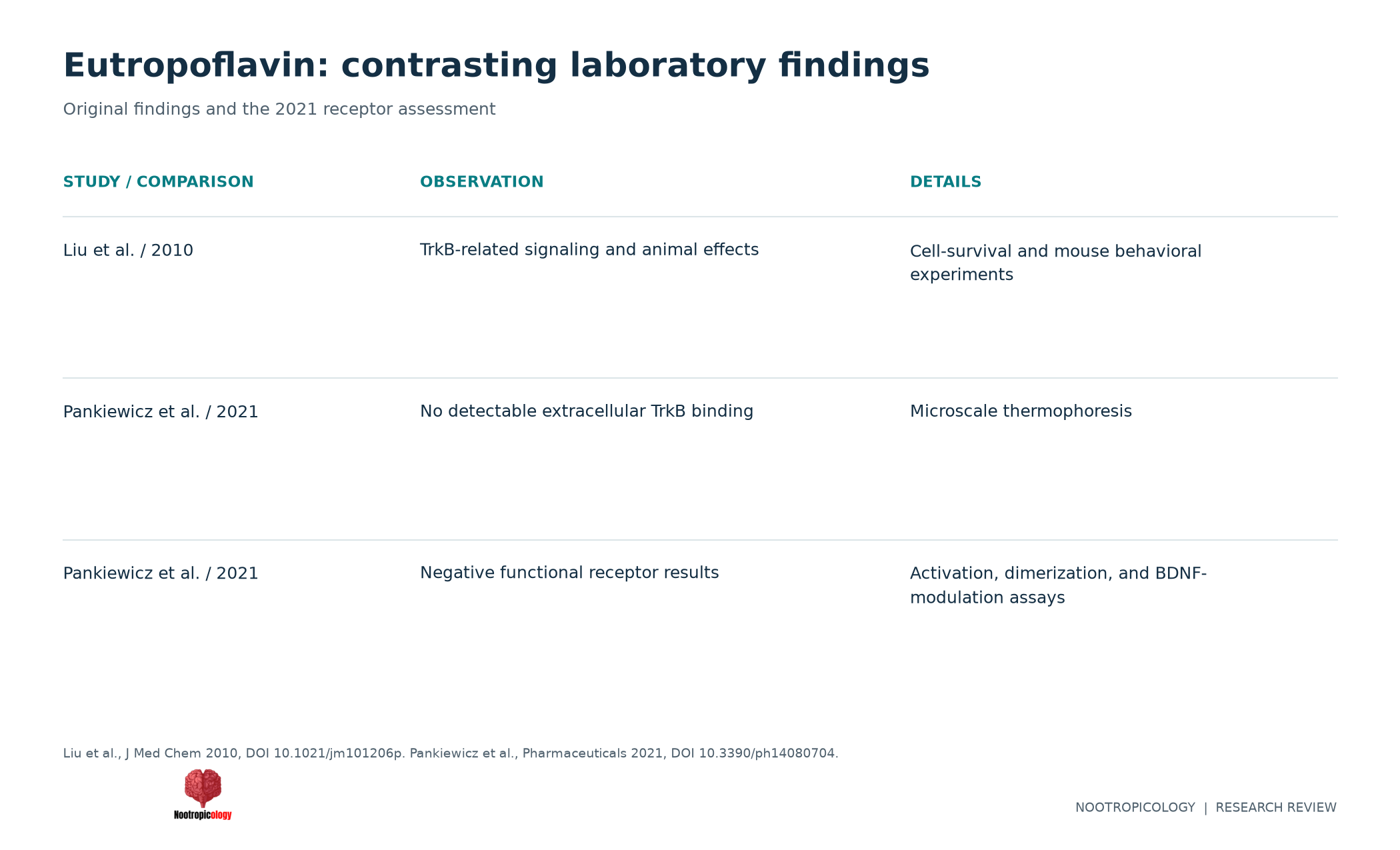
Pankiewicz and colleagues assessed several proposed small-molecule TrkB agonists in 2021. Microscale thermophoresis found no detectable binding of 4'-DMA-7,8-DHF to the extracellular TrkB domain. The functional assays also returned negative results for the expected TrkB agonist activity. [3]
Eutropoflavin Receptor Assays
The 2021 assessment examined binding, receptor activation, and dimerization, the pairing involved in receptor activation. It also tested whether the compounds enhanced BDNF's effects. For 4'-DMA-7,8-DHF, the tested systems showed neither the expected direct activation nor positive modulation of BDNF signaling. [3]
| Assay | Measurement | 2021 finding |
|---|---|---|
| Receptor binding | Microscale thermophoresis with the extracellular TrkB domain | No detectable binding. |
| Functional activity | Receptor activation and dimerization | Negative results for the expected activity. |
| BDNF modulation | Effect on the response to BDNF | No positive modulation in the tested systems. |
The 2021 group used purified extracellular TrkB for its binding experiments. Microscale thermophoresis measures changes in the movement of fluorescently labeled molecules across a temperature gradient. Binding alters that movement, allowing an affinity estimate when a reproducible concentration-dependent signal is present. Eutropoflavin produced no detectable binding signal in this assessment.
The researchers then examined functional receptor responses and whether two TrkB molecules paired together, a process called dimerization. They also tested positive allosteric modulation: whether a candidate compound amplified the response to BDNF already present. Eutropoflavin returned negative results across these approaches. The same paper reported no cytoprotective activity for the reference compounds in its functional assessment.
The disagreement centers on the experimental results themselves. The 2010 study measured phosphorylation and protective responses in cortical neurons and mouse tissue; the 2021 work combined direct receptor-binding measurements with a separate panel of functional assays. Both studies identify the tested derivative as 4'-dimethylamino-7,8-dihydroxyflavone.[3]
Eutropoflavin Benefits: What Has Been Studied?
The published Eutropoflavin findings concern neurotrophic signaling, cell survival, and animal behavior. The PubMed research reviewed for this article consisted of preclinical studies.
For related neurotrophic research, see our Noopept article.
Eutropoflavin Neurogenesis and Antidepressant-Like Effects
The original study reported neurogenesis in the mouse dentate gyrus, part of the hippocampal formation, following chronic oral administration. The same research program reported antiapoptotic activity and antidepressant-like behavioral effects. [2]
Adult male C57BL/6J mice received 5 mg/kg orally for 21 days in the original neurogenesis experiment. At the end of treatment, the investigators administered bromodeoxyuridine (BrdU), a marker incorporated during DNA synthesis. They examined the dentate gyrus 2 hours later and found more BrdU-labeled proliferating cells in treated animals than in vehicle-treated controls.
The behavioral experiment also followed 21 days of oral administration. Treated mice spent less time immobile in the forced-swim test. Researchers examined TrkB F616A knock-in mice to investigate the pathway further. This modified receptor can be selectively inhibited by the experimental compound 1NMPP1; applying that inhibitor eliminated the flavones' effect on immobility in those mice.[2]
Eutropoflavin Cell Survival Experiments
Cortical neurons were exposed to glutamate after pretreatment with the flavones. Investigators measured activated caspase-3, an enzyme involved in apoptosis. Both molecules reduced the glutamate-associated caspase-3 response at 50 nM and higher concentrations. At 10 nM, Eutropoflavin had a stronger inhibitory effect than 7,8-DHF.
A related mouse experiment used kainic acid to produce neural injury. The researchers tracked caspase-3 alongside TrkB phosphorylation after oral flavone administration. In the TrkB F616A animals, 1NMPP1 also abolished the protective response. These were the receptor-dependence experiments underlying the original paper's interpretation of Eutropoflavin's activity.[2]
The investigators followed the response at several points in the signaling chain. TrkB phosphorylation was measured alongside Akt and MAPK activation, and the cell-survival experiments used activated caspase-3 as their endpoint. In the chronic mouse experiments, hippocampal tissue staining and behavioral observations were collected after the same 21-day treatment period. The paper's proposed relationship between receptor signaling, cell proliferation, and behavior rests on this combination of measurements.[2]
Eutropoflavin vs. 7,8-DHF
| Feature | 7,8-DHF | Eutropoflavin |
|---|---|---|
| Chemical relationship | Parent flavone | 4'-dimethylamino derivative |
| Substituents | Hydroxyl groups at positions 7 and 8 | The same hydroxyl groups plus a 4'-dimethylamino group |
| Research context | Parent molecule in the structure-activity program | Derivative examined in the 2010 and 2021 studies |
A 2012 optimization study investigated a further modified lead containing a pyrrolidinyl substituent and a fused imidazole system. The researchers reported improved laboratory ADMET characteristics and antidepressant-like effects in mice for that modified structure. [4]
The original comparison also examined the time course after a 1 mg/kg oral dose in mice. TrkB activation with 7,8-DHF peaked at approximately 1 to 2 hours. With Eutropoflavin, the reported peak occurred at 4 hours, followed by a partial decline over 8 to 16 hours. Downstream Akt and MAPK signals were also stronger and lasted longer with the dimethylamino derivative in that experiment.
Substitution experiments helped explain why the researchers retained the adjacent hydroxyl groups. Replacing the 7-hydroxyl group with methoxy modestly reduced the measured activity. Replacing both hydroxyl groups with methoxy substantially reduced it. The authors also tested changes to the central ring and reported weaker activity when its oxygen was replaced with an NH group.[2]
Eutropoflavin Dosage and Half-Life
Human therapeutic dosage and elimination half-life remain uncharacterized in the research reviewed here. The available exposure data come from cell, liver-preparation, and animal experiments.
The original experiments used different exposures for different questions. Cell-signaling assays tested nanomolar concentrations, the mouse time-course comparison used 1 mg/kg orally, and the chronic neurogenesis and behavioral experiments used 5 mg/kg orally for 21 days. These measurements appear together in the literature because the study combined molecular, tissue, and behavioral investigations.
The reported 4-hour peak concerned TrkB activation after oral administration. It describes the timing of a measured biological response. Plasma elimination half-life requires a separate concentration-time measurement of the compound itself. The 2021 microsomal experiments measured metabolic disappearance in liver-derived preparations and reported intrinsic clearance, another distinct measurement.[2]
Eutropoflavin Solubility, Permeability, and Metabolic Stability
The 2021 profiling found low solubility under the tested conditions, favorable membrane-permeability measurements, and substantial instability in human and mouse liver microsomes. Microsomes are liver-derived preparations used to study metabolism. [3]
At pH 7.4, the 2021 study classified Eutropoflavin's kinetic solubility as below 100 micromolar. The test measured how much compound remained dissolved after incubation in an aqueous buffer. Solubility addresses the amount available in solution, while the permeability experiments address movement across a membrane once the compound is dissolved.
Permeability exceeded the study's favorable threshold of 10-6 cm/s in both a parallel artificial membrane permeability assay (PAMPA) and the Caco-2 system. PAMPA uses an artificial membrane, while Caco-2 uses a cultured cell layer. Agreement between the two measurements gave Eutropoflavin a favorable permeability profile under those laboratory conditions.
Eutropoflavin Liver Metabolism
The metabolic result went in the opposite direction. Human and mouse liver microsomes degraded Eutropoflavin faster than the high-clearance reference compound verapamil. The researchers classified it as highly unstable in both species. Their analysis tracked the disappearance of the parent compound by liquid chromatography-mass spectrometry and expressed clearance relative to microsomal protein content.[3]
For the microsomal analysis, investigators incubated the compound with liver preparations and NADPH, a cofactor used by several metabolic enzymes. Samples were collected over the incubation period, and the remaining parent compound was measured against an internal analytical standard. Parallel human and mouse preparations allowed the same assay conditions to be compared between species.
The paper also tested chemical stability in buffer separately from enzymatic stability in microsomes. That distinction matters when reading an ADME table: low aqueous solubility, membrane transport, chemical breakdown, and liver-enzyme metabolism describe separate properties. Eutropoflavin combined favorable membrane transport with low solubility and rapid microsomal loss in this dataset.[3]
Eutropoflavin Side Effects and Safety
The reviewed literature provides preclinical activity and metabolic data. Human adverse-event rates remain uncharacterized. The Reddit discussion below includes reports of anxiety, impaired concentration, and sleep changes during use alongside other compounds.
Eutropoflavin User Experiences and Reddit Reviews
In a September 2026 r/Nootropics thread, the original poster described anxiety, reduced concentration, and later difficulty falling asleep while experimenting with Eutropoflavin alongside other compounds. Another commenter described calmer focus and less resistance to starting tasks. [5]

The original poster also used piracetam, cytisine, and Noopept. Their later updates describe changing amounts, pauses in use, and changes in sleep and task switching.
Where to Buy Eutropoflavin: Swisschems Product Details
Swisschems lists 4'-DMA-7,8-DHF (Eutropoflavin) as 60 capsules containing 10 mg each, designated for research use.
Eutropoflavin Review Conclusion
Eutropoflavin's research record centers on a specific disagreement: the original study reported TrkB-related and behavioral effects, while the 2021 assessment found negative results in receptor-binding and functional assays. Its chemistry, animal findings, and laboratory metabolism data are better characterized than its effects in people.
Frequently Asked Questions About Eutropoflavin
The main Eutropoflavin questions concern its relationship to 7,8-DHF, TrkB activity, and cognitive research.
What Is Eutropoflavin Used For?
Eutropoflavin is used in experimental research on neurotrophic signaling, cell survival, and depression-related behavior. The original study reported increased neurogenesis and antidepressant-like effects in mice. Human treatment benefits have not been established.
How Does Eutropoflavin Differ From 7,8-DHF?
The difference between Eutropoflavin and 7,8-DHF is an additional dimethylamino group at the 4' position of the flavone structure. Eutropoflavin is therefore also called 4'-DMA-7,8-DHF. Its molecular formula is C17H15NO4, and its molecular weight is 297.30 g/mol.
Does Eutropoflavin Activate TrkB?
Whether Eutropoflavin directly activates TrkB remains disputed. The original study reported TrkB-related activity and effects in cells and mice. A 2021 assessment found no detectable receptor binding and negative results in the tested functional assays.
Do BDNF Supplements Such as Eutropoflavin Actually Work?
Eutropoflavin has not been shown to deliver the advertised benefits of a BDNF supplement in human trials. The original laboratory and animal study reported neurogenesis and behavioral changes in mice. Later experiments returned negative results for the expected direct TrkB activity.
Does Eutropoflavin Increase IQ?
Eutropoflavin has not been shown to increase human IQ. The studies reviewed here measured receptor activity, cellular markers, and mouse behavior. They did not measure changes in human intelligence-test scores.
- National Center for Biotechnology Information. "PubChem Compound Summary for CID 44610701, Eutropoflavin." PubChem (accessed 6 Nov. 2026). ↑ ↑
- Liu, Xia et al. "A synthetic 7,8-dihydroxyflavone derivative promotes neurogenesis and exhibits potent antidepressant effect." Journal of medicinal chemistry vol. 53,23 (2010): 8274. doi:10.1021/jm101206p. ↑ ↑ ↑ ↑ ↑ ↑ ↑ ↑ ↑ ↑
- Pankiewicz, Piotr, et al. "Do Small Molecules Activate the TrkB Receptor in the Same Manner as BDNF? Limitations of Published TrkB Low Molecular Agonists and Screening for Novel TrkB Orthosteric Agonists." Pharmaceuticals vol. 14,8 (2021): 704. doi:10.3390/ph14080704. ↑ ↑ ↑ ↑ ↑ ↑ ↑ ↑
- Liu, Xia et al. "Optimization of a small tropomyosin-related kinase B (TrkB) agonist 7,8-dihydroxyflavone active in mouse models of depression." Journal of medicinal chemistry vol. 55,19 (2012): 8524. doi:10.1021/jm301099x. ↑
- Reddit contributors. "Eutropoflavin / 4 DMA-7,8 DHF - experiences?." r/Nootropics (12 Sept. 2026). ↑